Issue 105Published November 19, 2026
Editor noteThis archived Ash AI Daily issue retains the delivered editorial briefing and final cards.
 Ash SystemsAI NewsletterDaily Issue
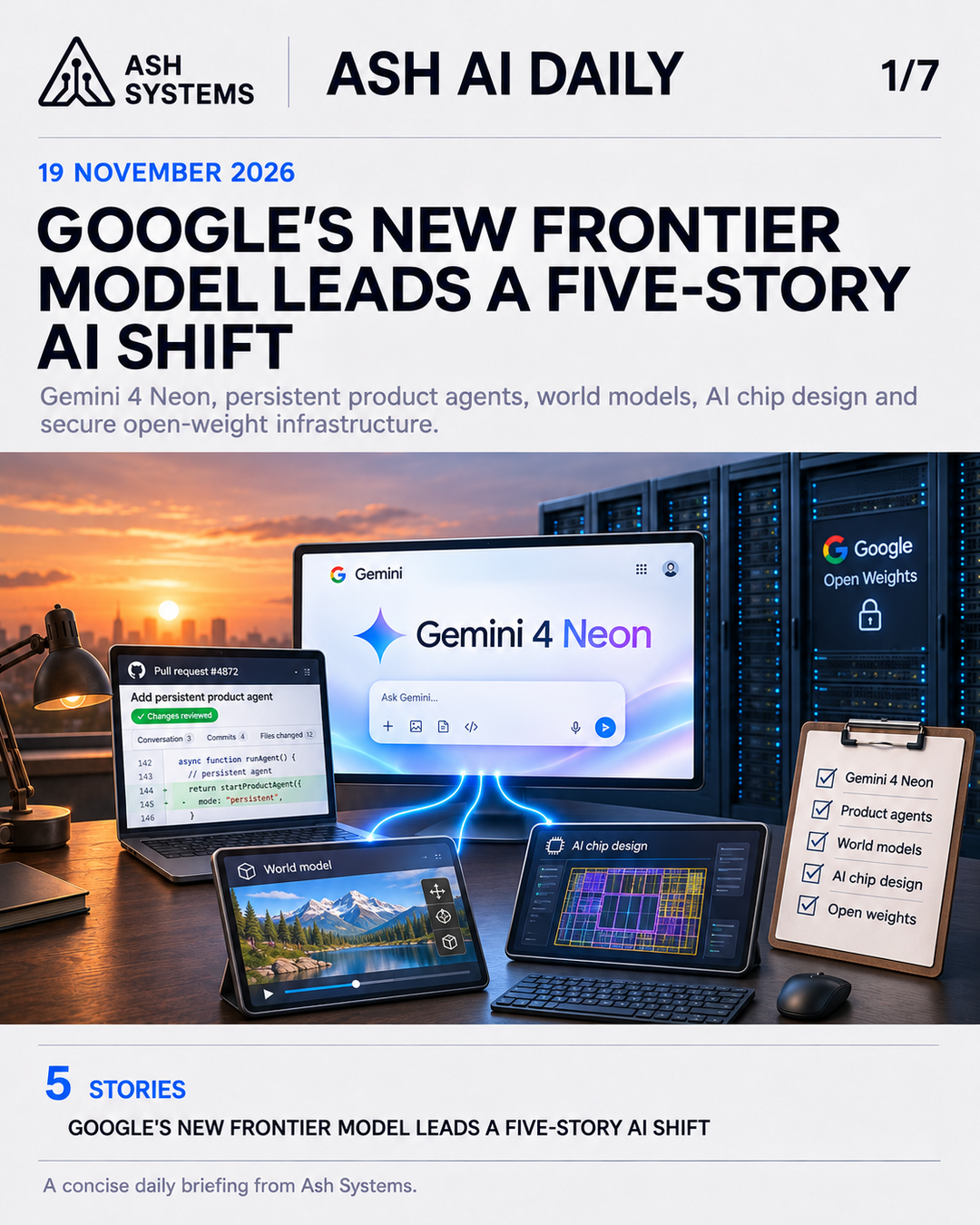
Five verified developments spanning frontier models, persistent product agents, world models, AI-assisted chip design and secure open-weight infrastructure.
This archived Ash AI Daily issue retains the delivered editorial briefing and final cards.
Each story keeps its image, summary, impact, and linked sources in one uninterrupted reading flow.
This archived Ash AI Daily issue retains the delivered editorial briefing and final cards.
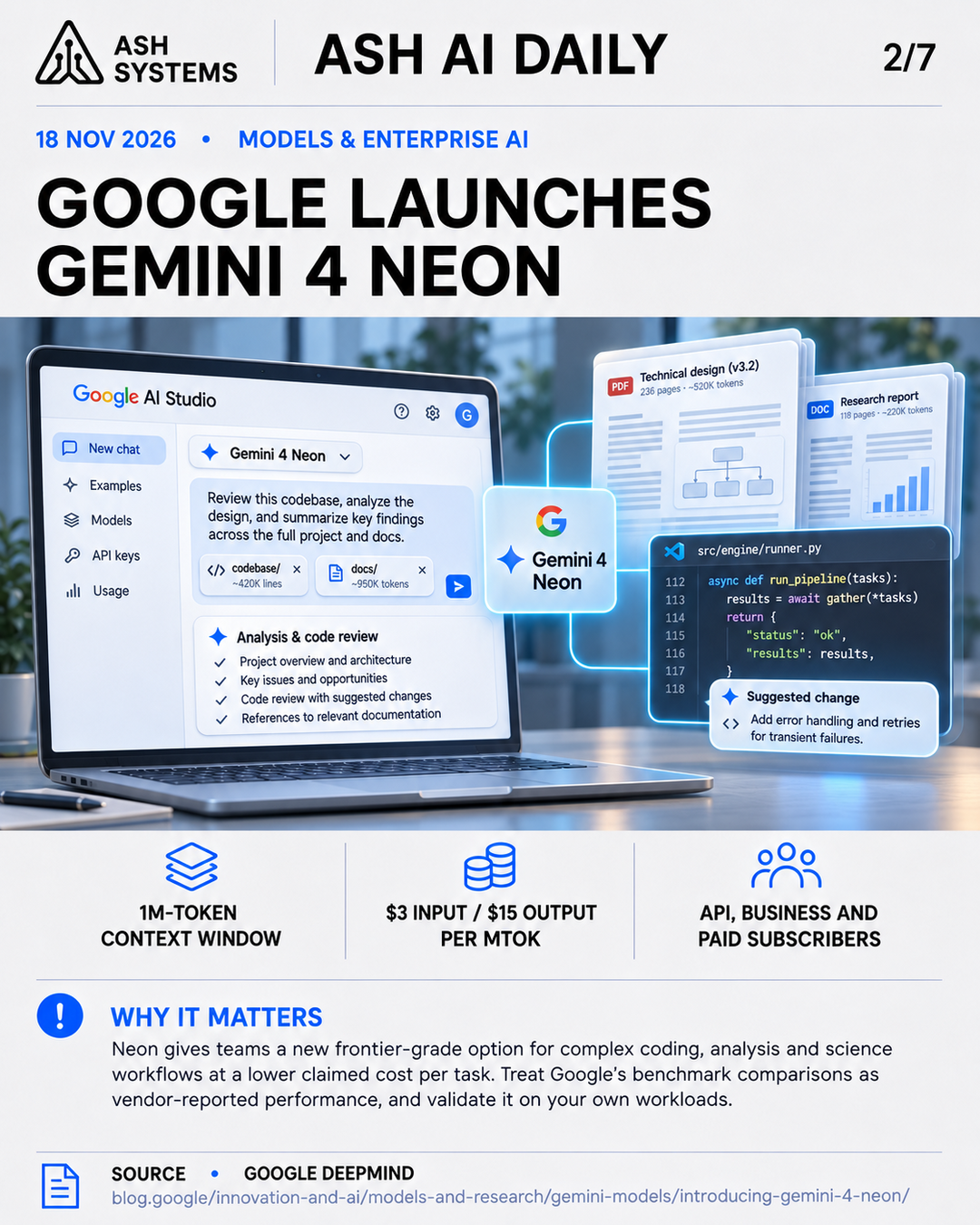
Google introduced Gemini 4 Neon for the Gemini API, Gemini for business and paid consumer tiers. It has a 1 million-token context window and listed API pricing of $3 per million input tokens and $15 per million output tokens. Google describes its benchmark comparisons as its own or third-party measurements, so teams should validate fit on representative workloads.
A frontier-oriented model at this price and context size could change the economics of high-volume coding, analysis and research workflows. The practical question is whether Neon improves reliability, latency and cost on the workflows a team already runs.
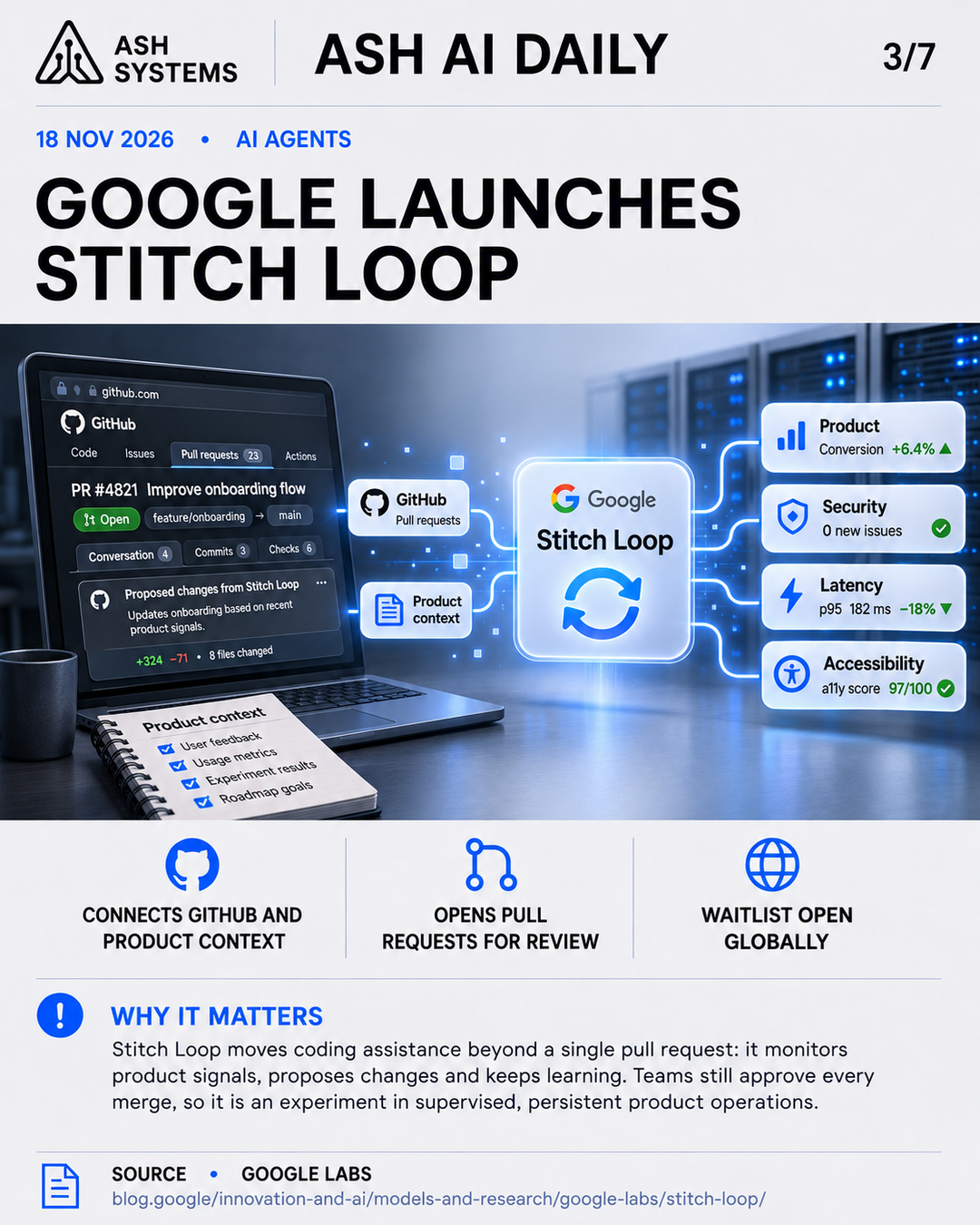
Google Labs unveiled Stitch Loop, an experiment that connects a codebase with product context such as logs, behavior and feedback. It proposes work, writes code in an isolated cloud sandbox and opens pull requests; Google says every merge still requires user review. The global waitlist is open, with priority for eligible Google AI Ultra users.
This is a meaningful shift from one-off coding assistance toward persistent, measured product operations. The review gate lets businesses explore continuous optimization without granting an agent unilateral production changes.
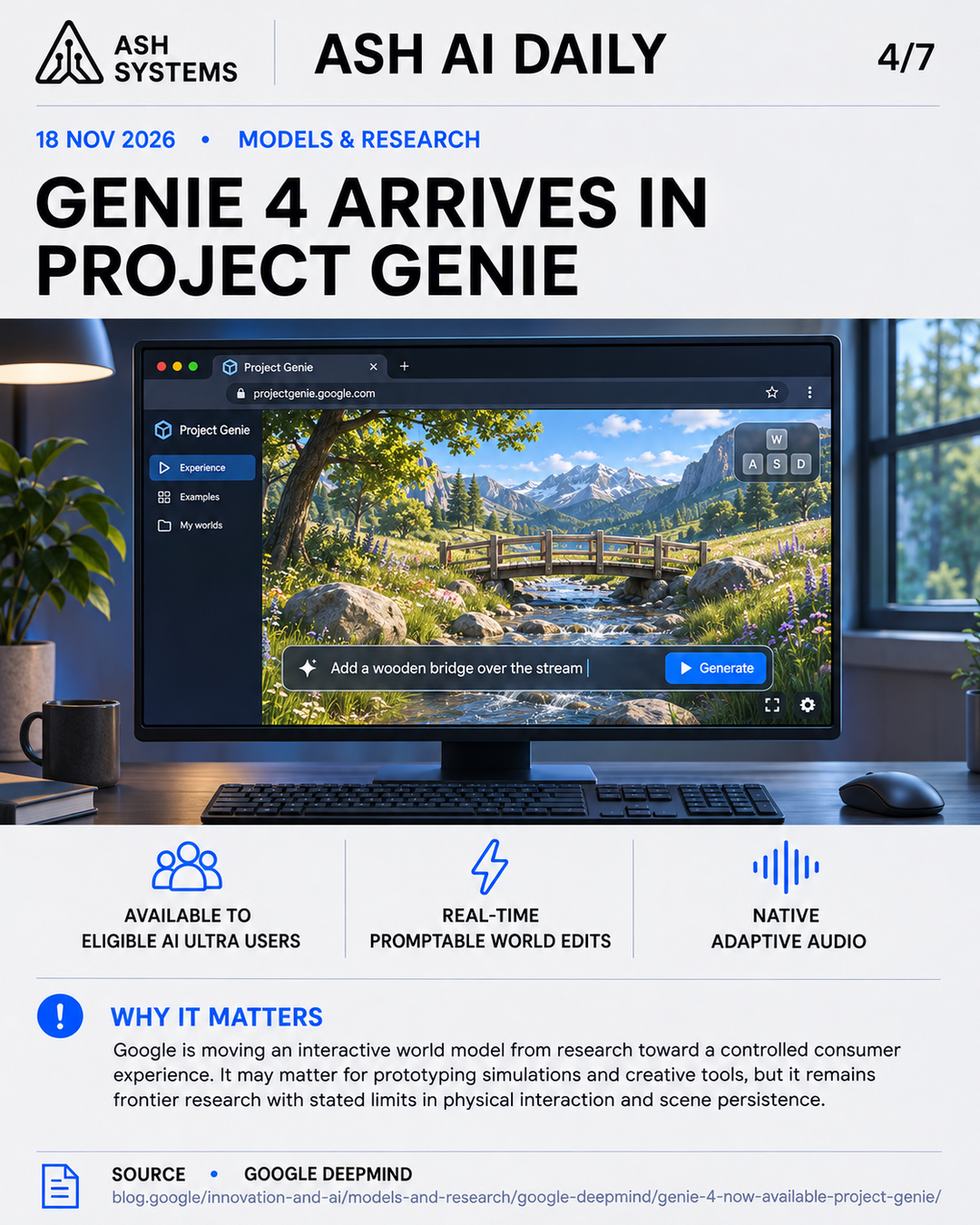
Google is rolling out its Genie 4 interactive-world model to eligible Google AI Ultra subscribers through Project Genie. The update adds real-time promptable edits and native adaptive audio; Google also says the experience includes a creative agent and a community gallery. It continues to characterize Genie as frontier research with limitations including physical interactions and long-term scene persistence.
World models are becoming usable tools, not just research demos. That creates near-term opportunities for creative prototyping and simulation, while the stated limitations mean it should not be mistaken for a reliable physical-world simulator.
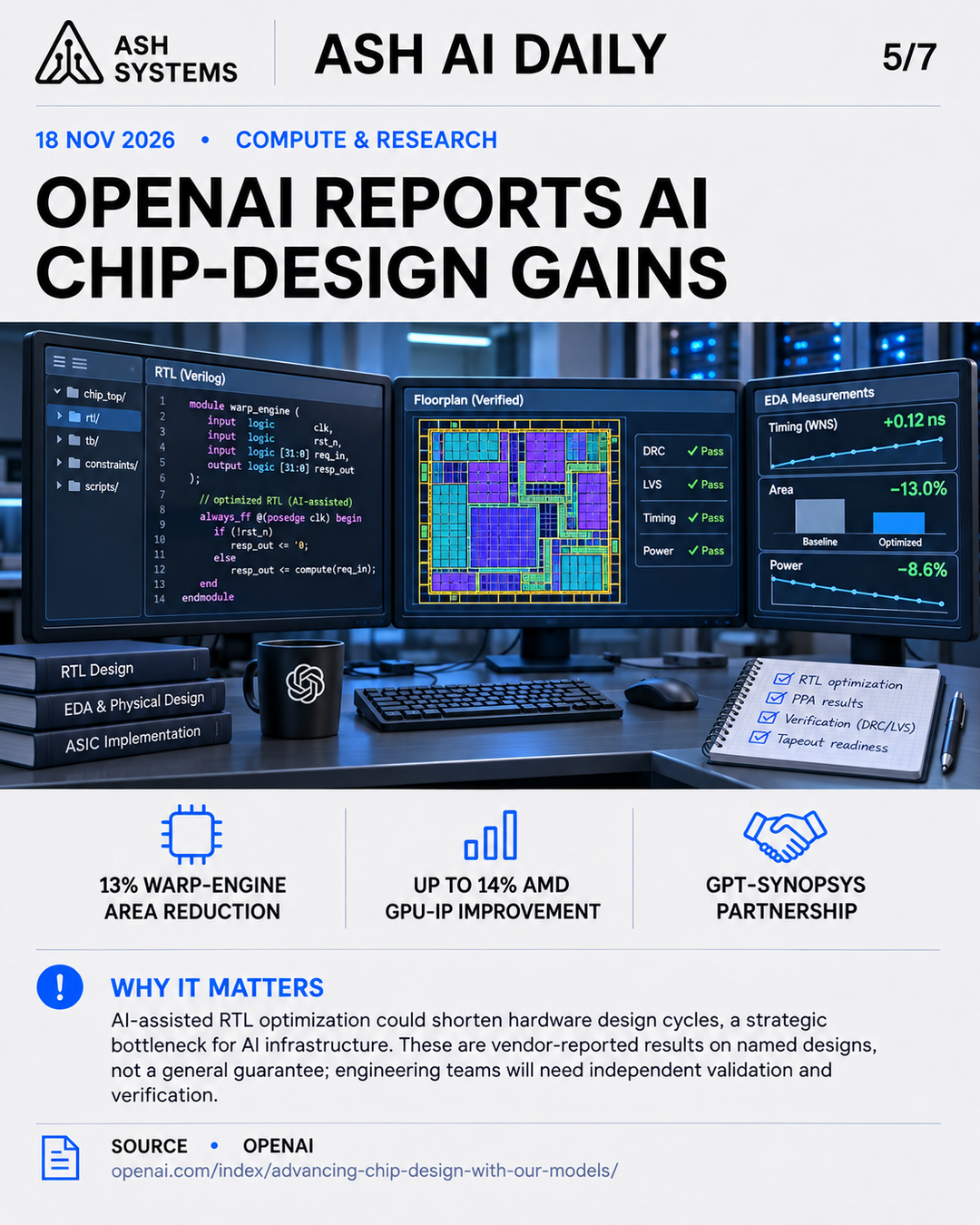
OpenAI reported model-proposed changes reduced standard-cell area by about 13% in a Jalapeño warp engine and 10% in a matrix unit. It also reported up to 14% improvement against heavily optimized AMD flagship GPU-IP baselines and said it is partnering with Synopsys on GPT-Synopsys. These are vendor-reported engineering results, though OpenAI says some changes entered manufacturing or production design files.
Hardware design is a strategic AI bottleneck. If AI can accelerate verified RTL optimization, it may shorten iteration cycles for chips that underpin future AI capacity—but production use still depends on rigorous verification and physical-design constraints.

Palo Alto Networks announced a definitive agreement to acquire Applied Compute, which it describes as a platform for post-training and inference of open-weight AI models. The all-stock proposed transaction is valued at $4.5 billion, subject to adjustments and regulatory clearance, with an expected close in Palo Alto Networks' fiscal third quarter of 2027.
The deal puts secure deployment of open-weight models at the center of a major security platform’s AI strategy. It signals enterprise demand for control over model adaptation, inference and cloud placement alongside security.
This issue includes a closing visual to carry the next-day watchlist or wrap-up prompt alongside the main briefing.
Join the source-linked daily briefing and confirm once before delivery begins.
Ash AI Daily

A concise, source-linked read on the AI news that changes what teams can build.
You will receive a confirmation email before any daily issue is sent.