Issue 90Published November 4, 2026
Editor noteThis archived Ash AI Daily issue retains the delivered editorial briefing and final cards.
 Ash SystemsAI NewsletterDaily Issue
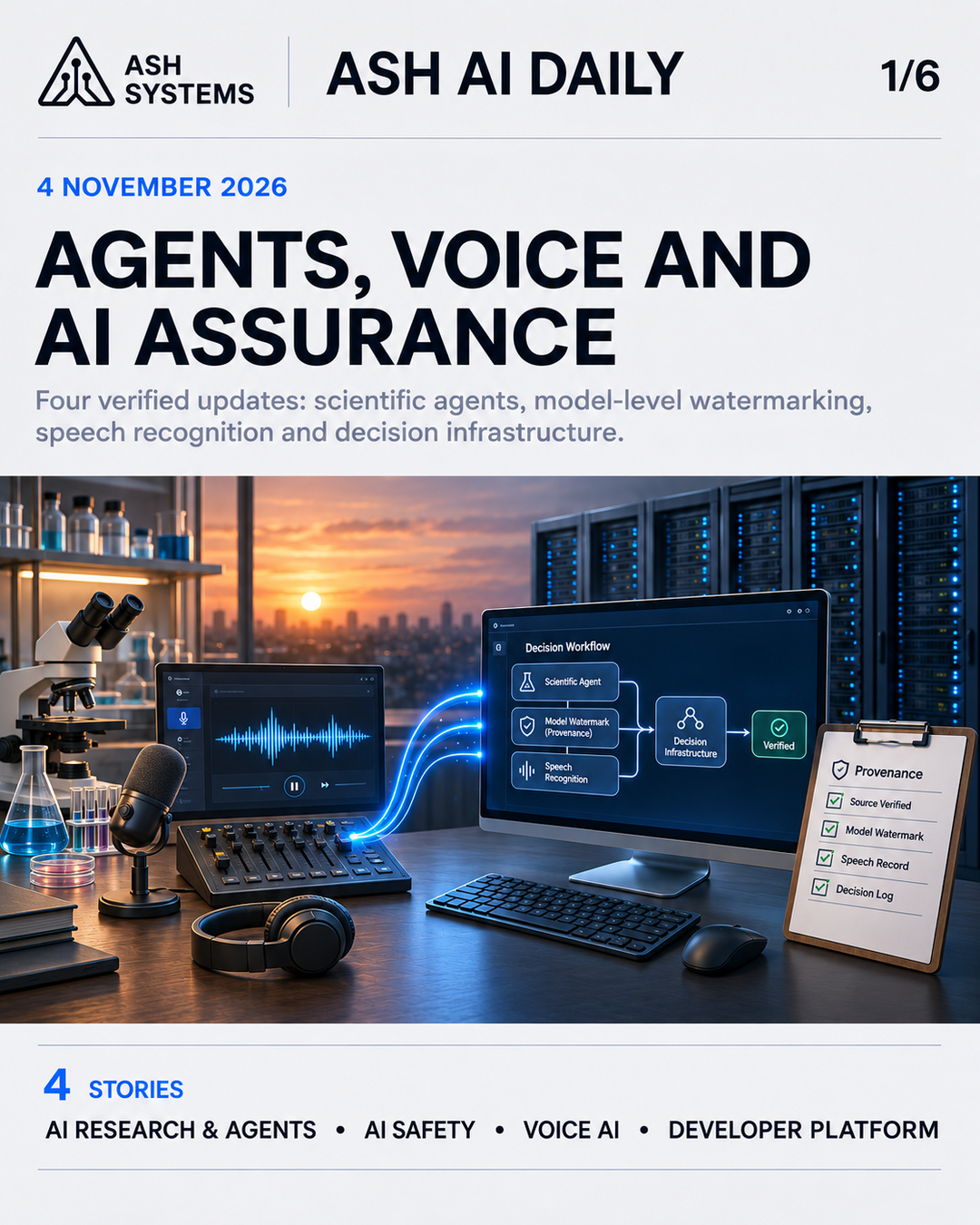
Four verified signals spanning scientific agents, provenance, speech AI and structured decision infrastructure.
This archived Ash AI Daily issue retains the delivered editorial briefing and final cards.
Each story keeps its image, summary, impact, and linked sources in one uninterrupted reading flow.
This archived Ash AI Daily issue retains the delivered editorial briefing and final cards.
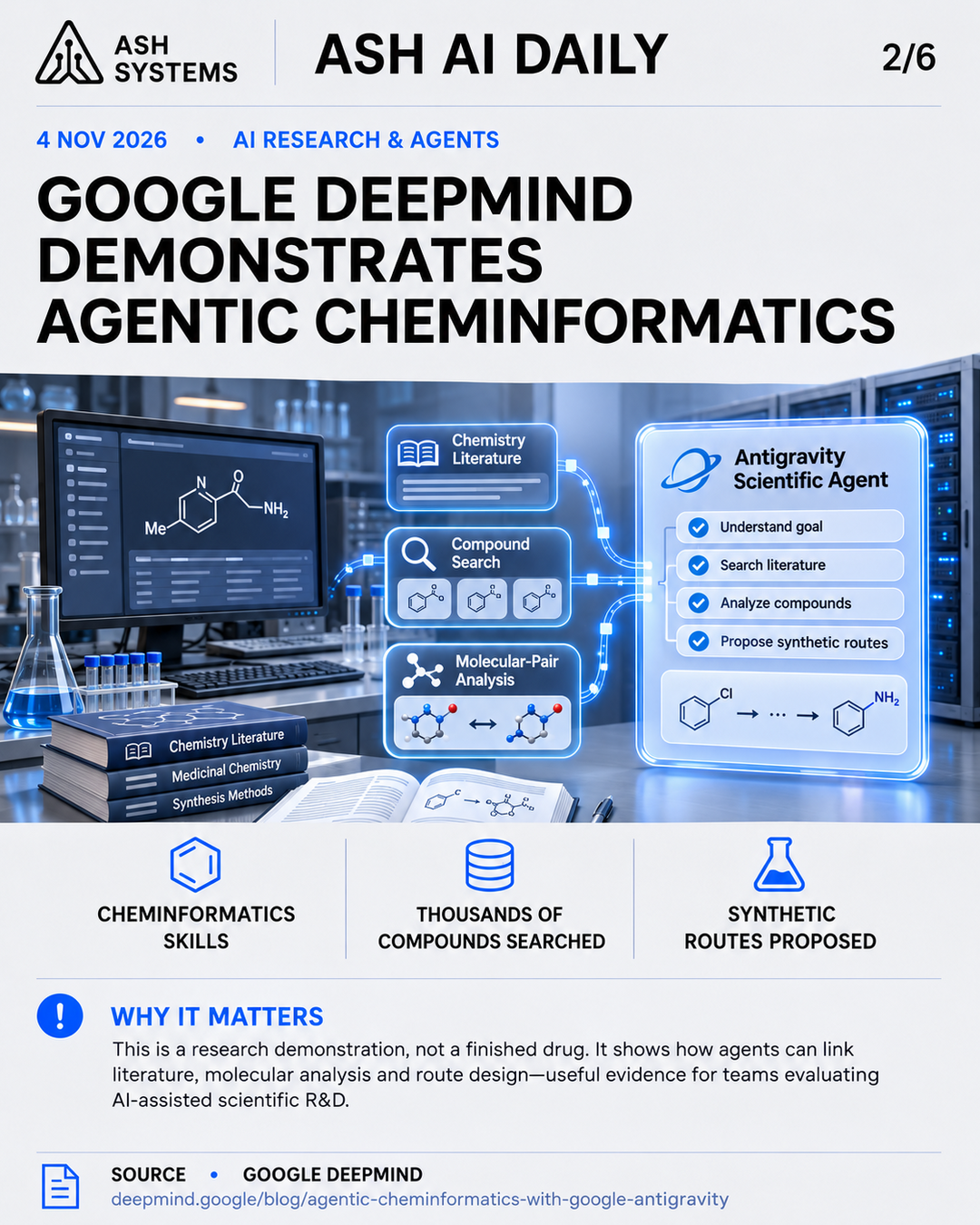
Google DeepMind published a demonstration of Cheminformatics Skills in Google Antigravity. In a workflow using real-world lung-cancer treatments, the agent searched thousands of compounds, performed matched molecular-pair analysis and proposed candidate macrocycles and synthetic routes. Google says the workflow can complete in about an hour, but the proposed designs still require synthesis and experimental validation.
This is early applied research rather than a deployed drug-discovery product. It is useful evidence that agent workflows can connect literature retrieval, deterministic chemistry tools and model-based analysis while keeping scientists responsible for the validation boundary.
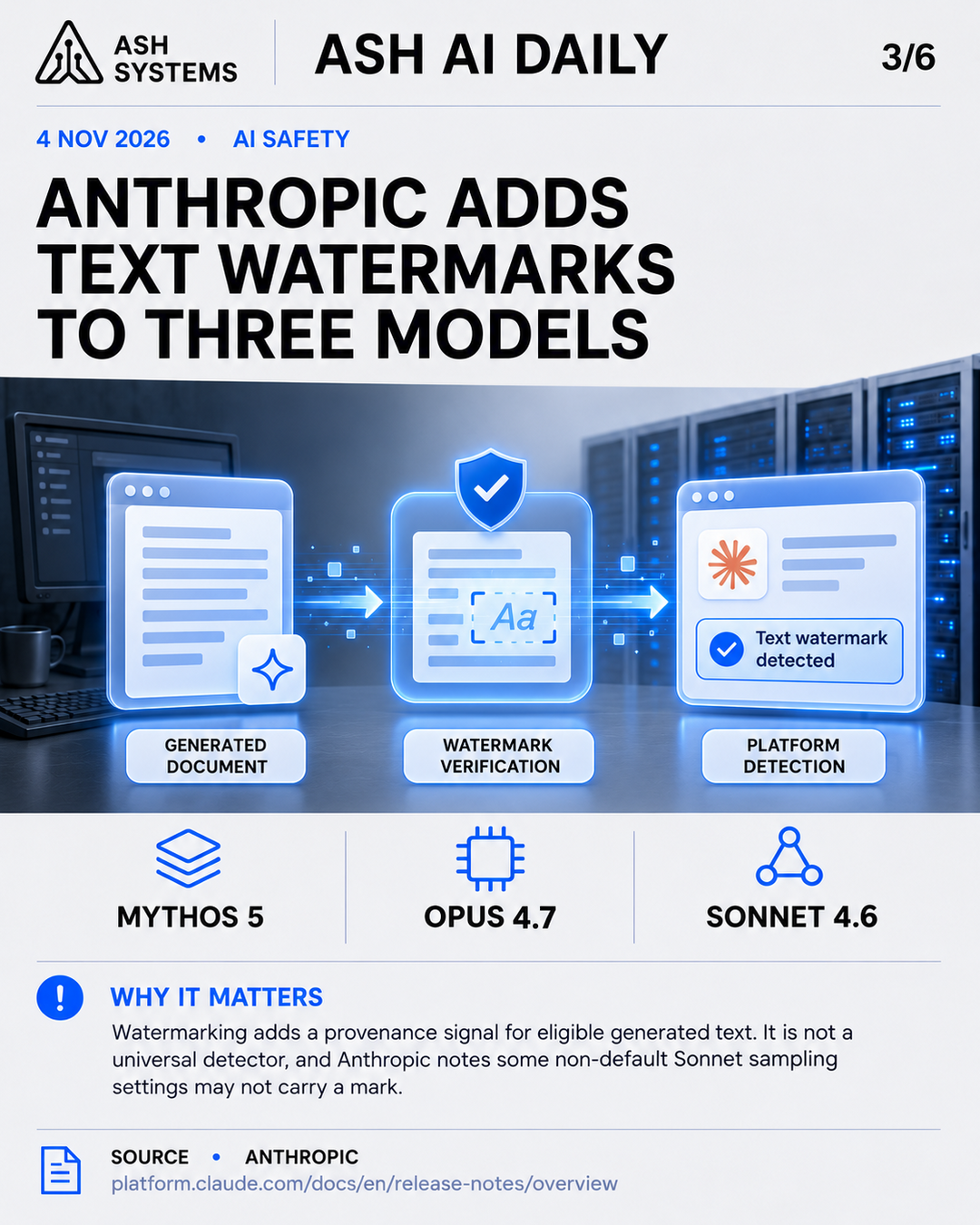
Anthropic’s 3 November platform release notes say text generated by Claude Mythos 5, Claude Opus 4.7 and Claude Sonnet 4.6 now carries Anthropic’s text watermark on supported platforms. Anthropic also documents that Sonnet 4.6 output generated with non-default temperature, top_p or top_k settings may not carry a watermark.
Watermarks add a provenance signal for eligible content, not a universal detector of AI text. Teams designing review, moderation or disclosure controls should treat it as one input and preserve the documented coverage limits in their policy and tooling.
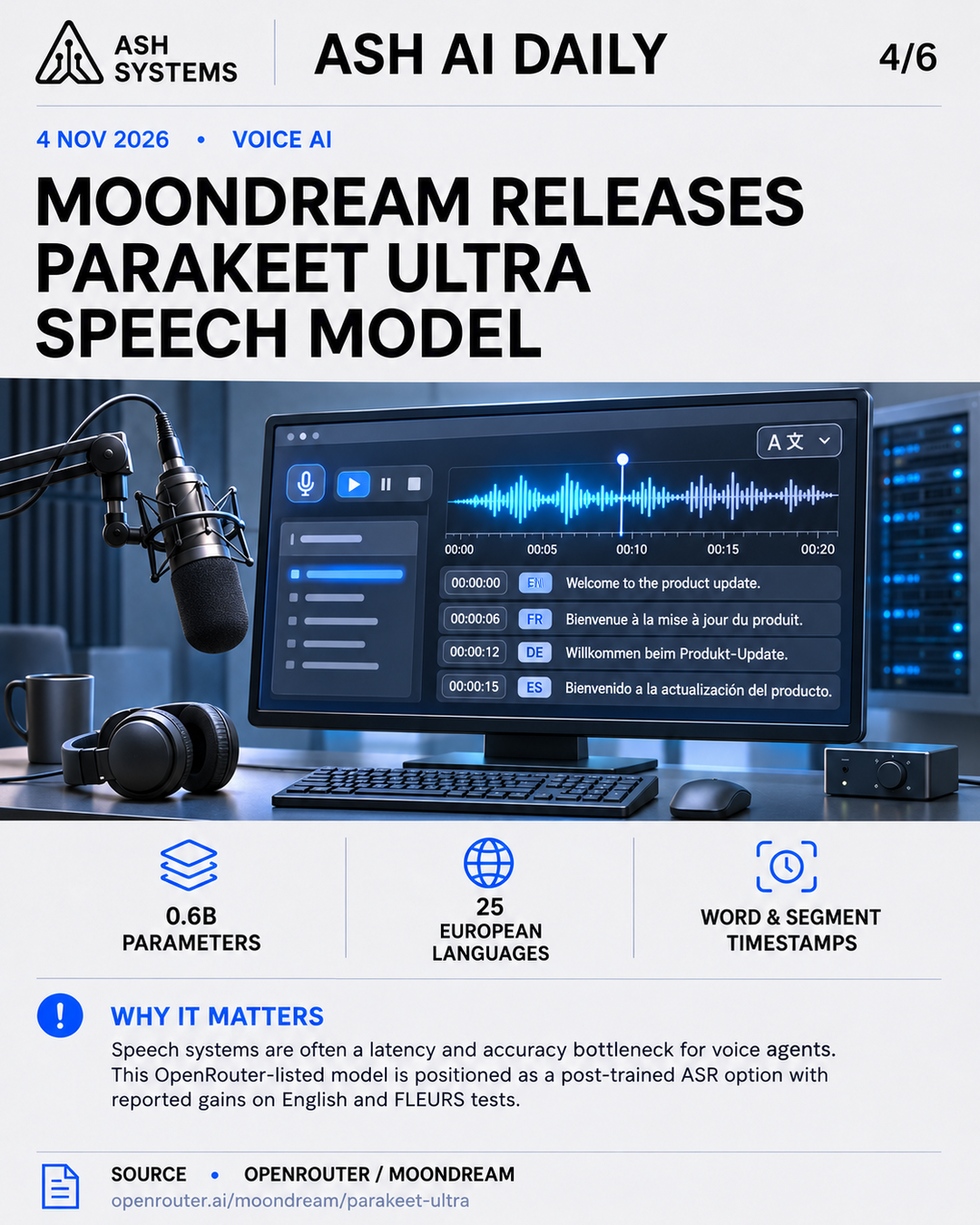
OpenRouter lists Moondream’s Parakeet Ultra as a post-trained version of NVIDIA’s Parakeet TDT 0.6B v3 speech-to-text model. The listing describes 25 European languages, word and segment timestamps, and vendor-reported lower word-error rates on Open ASR Leaderboard English sets and FLEURS than the base model.
Transcription accuracy and timing remain practical bottlenecks for voice agents. The reported results are vendor-supplied, so teams should benchmark it on their own accents, noise conditions and latency requirements before replacing an existing ASR path.
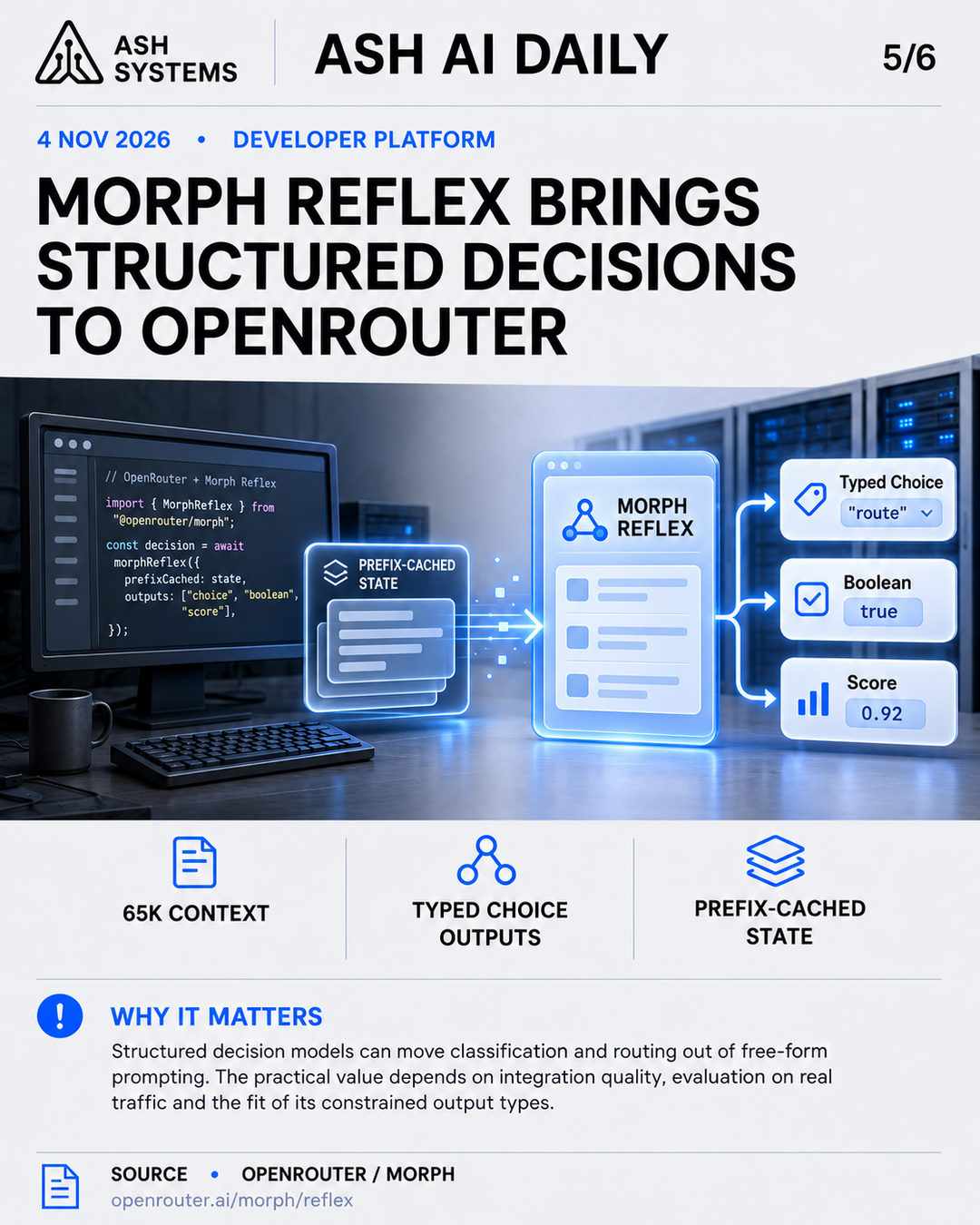
OpenRouter lists Morph Reflex, released 3 November, as a decision model for typed choice, boolean and score questions. Its documentation describes a 65,536-token context window and prefix-cached state across repeated questions, positioning it for repeated structured decisions rather than open-ended generation.
A constrained output contract can simplify routing and classification pipelines that otherwise parse free-form model text. The practical gain depends on the integration, the relevance of its allowed outputs and evaluation on the organisation’s actual traffic.
This issue includes a closing visual to carry the next-day watchlist or wrap-up prompt alongside the main briefing.
Join the source-linked daily briefing and confirm once before delivery begins.
Ash AI Daily

A concise, source-linked read on the AI news that changes what teams can build.
You will receive a confirmation email before any daily issue is sent.