
Ash SystemsAsh Systems
HomeServicesSolutionsProductsIndustriesAboutDocsAI NewsletterFAQContact
Contact
Ash SystemsAsh SystemsAI NewsletterDaily Issue

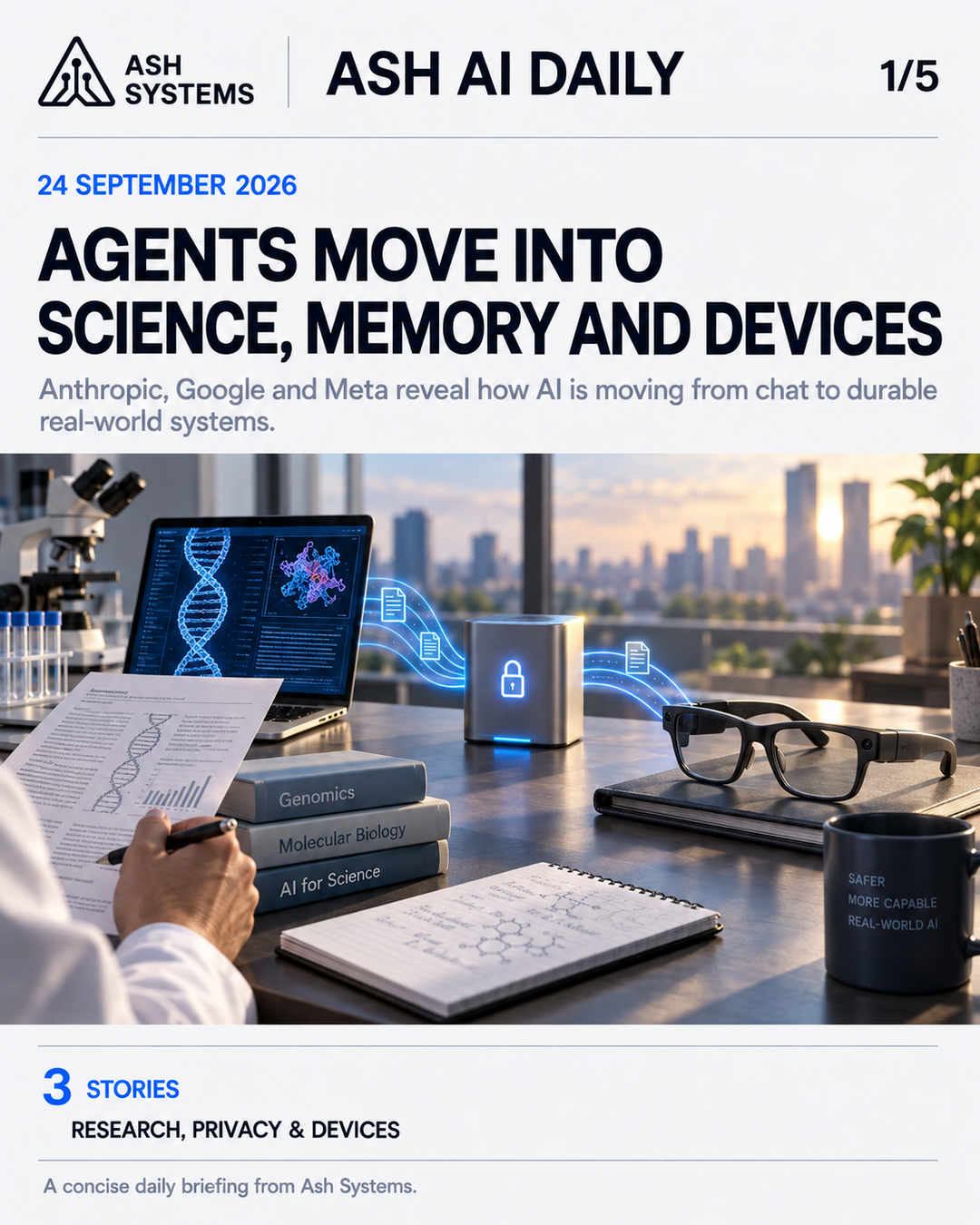
Ash AI Daily — agents move into science, memory and devices

Three verified developments show AI moving from model capability into laboratory discovery, privacy-preserving personal context and hands-free agent hardware.

September 24, 2026Issue 493 stories

This archived Ash AI Daily issue retains the delivered editorial briefing and final cards.

Issue structure

Cover card, canonical issue note, then the full story rail.

Each story keeps its image, summary, impact, and linked sources in one uninterrupted reading flow.

Ash AI Daily cover for Ash AI Daily — agents move into science, memory and devices
Issue 49Published September 24, 2026
Editor note

This archived Ash AI Daily issue retains the delivered editorial briefing and final cards.
Reading guide

In this issue

Jump straight to any source-backed story in this daily briefing.

  1. 01Anthropic reports Claude-assisted discovery of an enzyme system with CRISPR-like repeats
  2. 02Google details encrypted, persistent server-side memory for Private AI Compute
  3. 03Meta expands AI glasses with Muse agent access and new audio hardware
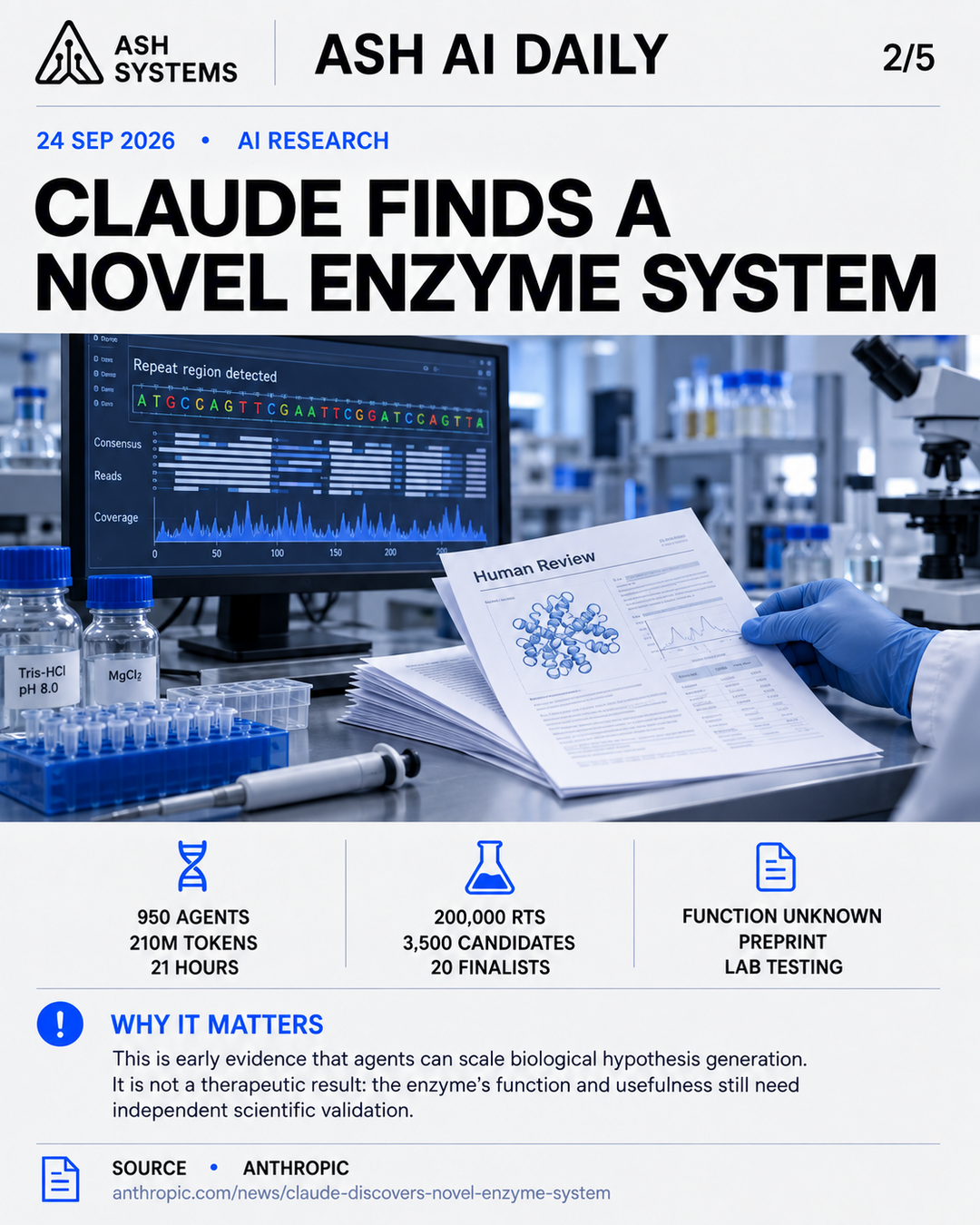
Anthropic reports Claude-assisted discovery of an enzyme system with CRISPR-like repeats Ash AI Daily factual story card
Story 1AI Daily

Anthropic reports Claude-assisted discovery of an enzyme system with CRISPR-like repeats

Anthropic says a multi-agent research run used about 950 agents, 210 million tokens and 21 hours to search more than 200,000 reverse transcriptases. It narrowed 3,500 candidates to 20 and identified an array-associated reverse transcriptase system with CRISPR-like repeats.

  • Anthropic says a multi-agent research run used about 950 agents, 210 million tokens and 21 hours to search more than 200,000 reverse transcriptases. It narrowed 3,500 candidates to 20 and identified an array-associated reverse transcriptase system with CRISPR-like repeats.
Why it matters

This is an early but concrete test of agentic research: models generated and triaged biological hypotheses at a scale that could compress exploratory work. It is not a deployed therapeutic result; the enzyme’s function and usefulness still need independent scientific validation.
Sources
Anthropic reports Claude-assisted discovery of an enzyme system with CRISPR-like repeatsAnthropic — Claude discovers a novel enzyme system · Sep 24, 2026
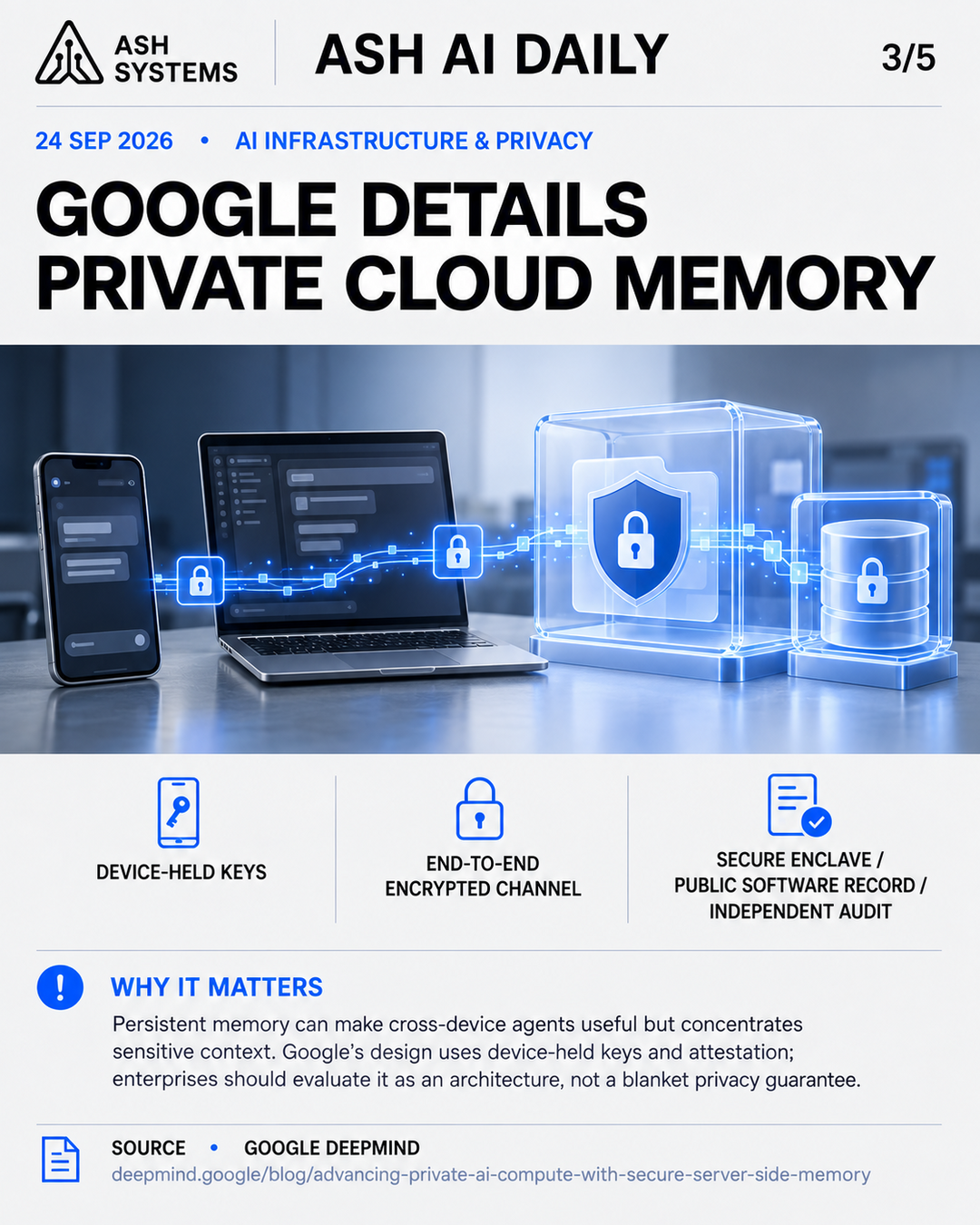
Google details encrypted, persistent server-side memory for Private AI Compute Ash AI Daily factual story card
Story 2AI Daily

Google details encrypted, persistent server-side memory for Private AI Compute

Google says its Private AI Compute design keeps encryption keys exclusively on personal devices, sends requests over an authenticated end-to-end encrypted channel to an isolated cloud secure enclave, and lets devices verify a tamper-proof public record of server software before data is sent.

  • Google says its Private AI Compute design keeps encryption keys exclusively on personal devices, sends requests over an authenticated end-to-end encrypted channel to an isolated cloud secure enclave, and lets devices verify a tamper-proof public record of server software before data is sent.
Why it matters

Persistent memory is central to useful cross-device agents, but it concentrates sensitive context. Google’s design attempts to make cloud-scale memory behave like on-device data through device-held keys and attestation; enterprises should treat it as an architecture to evaluate, not a blanket privacy guarantee.
Sources
Google details encrypted, persistent server-side memory for Private AI ComputeGoogle DeepMind — Advancing Private AI Compute with secure server-side memory · Sep 24, 2026
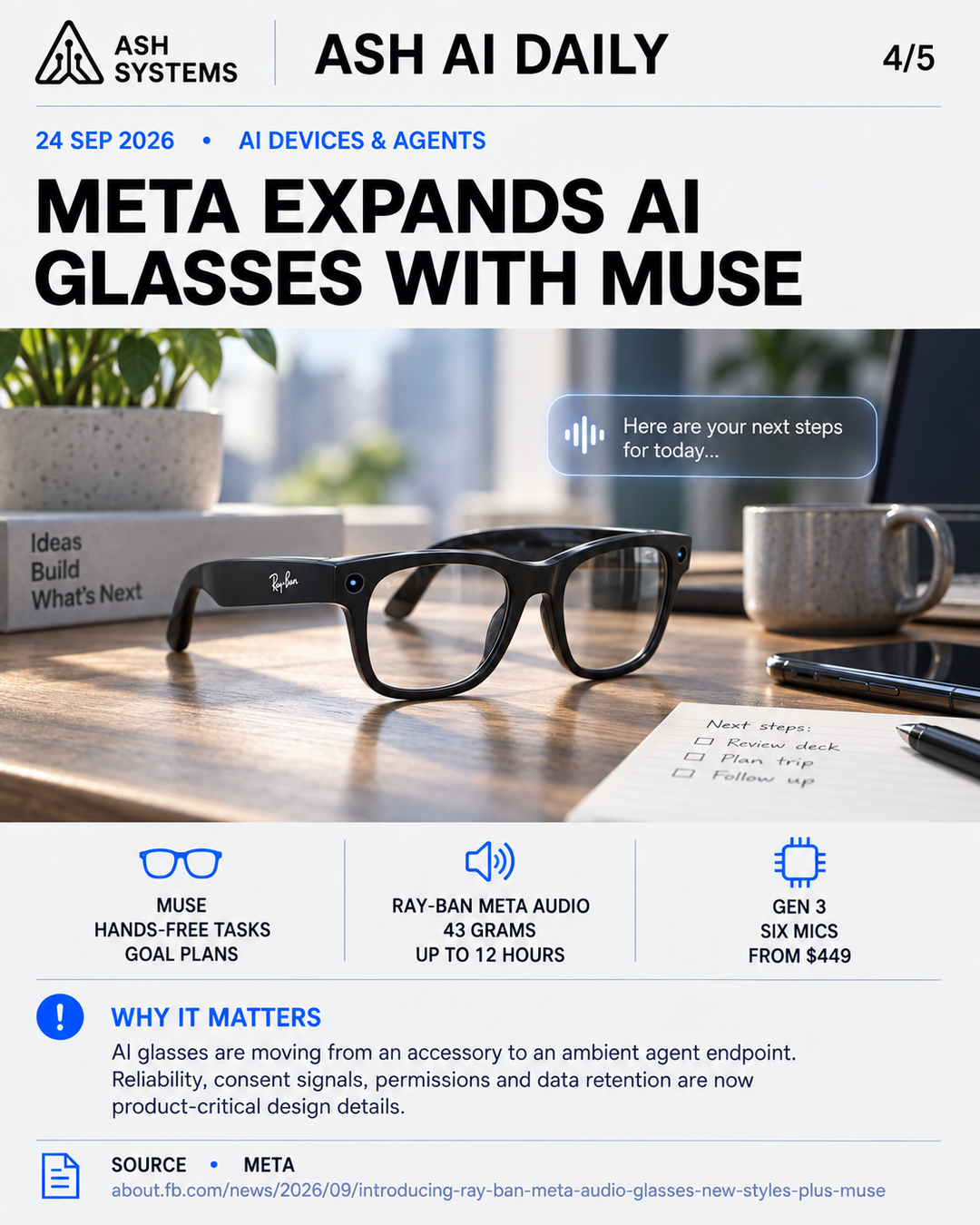
Meta expands AI glasses with Muse agent access and new audio hardware Ash AI Daily factual story card
Story 3AI Daily

Meta expands AI glasses with Muse agent access and new audio hardware

Meta says Muse will connect its personal AI agent to glasses for hands-free task and goal assistance. Ray-Ban Meta Audio is listed at 43 grams, up to 12 hours of battery life and a $349 starting price; Meta also says Gen 3's six-microphone array cuts more than 90% of background noise.

  • Meta says Muse will connect its personal AI agent to glasses for hands-free task and goal assistance. Ray-Ban Meta Audio is listed at 43 grams, up to 12 hours of battery life and a $349 starting price; Meta also says Gen 3's six-microphone array cuts more than 90% of background noise.
Why it matters

The shift is from a camera-and-audio accessory toward an ambient agent endpoint: a device that can capture context, hear requests and act without a phone in hand. That makes reliability, consent signals, permissions and data retention product-critical rather than secondary design details.
Sources
Meta expands AI glasses with Muse agent access and new audio hardwareMeta — Introducing Ray-Ban Meta Audio glasses, new styles plus Muse · Sep 24, 2026
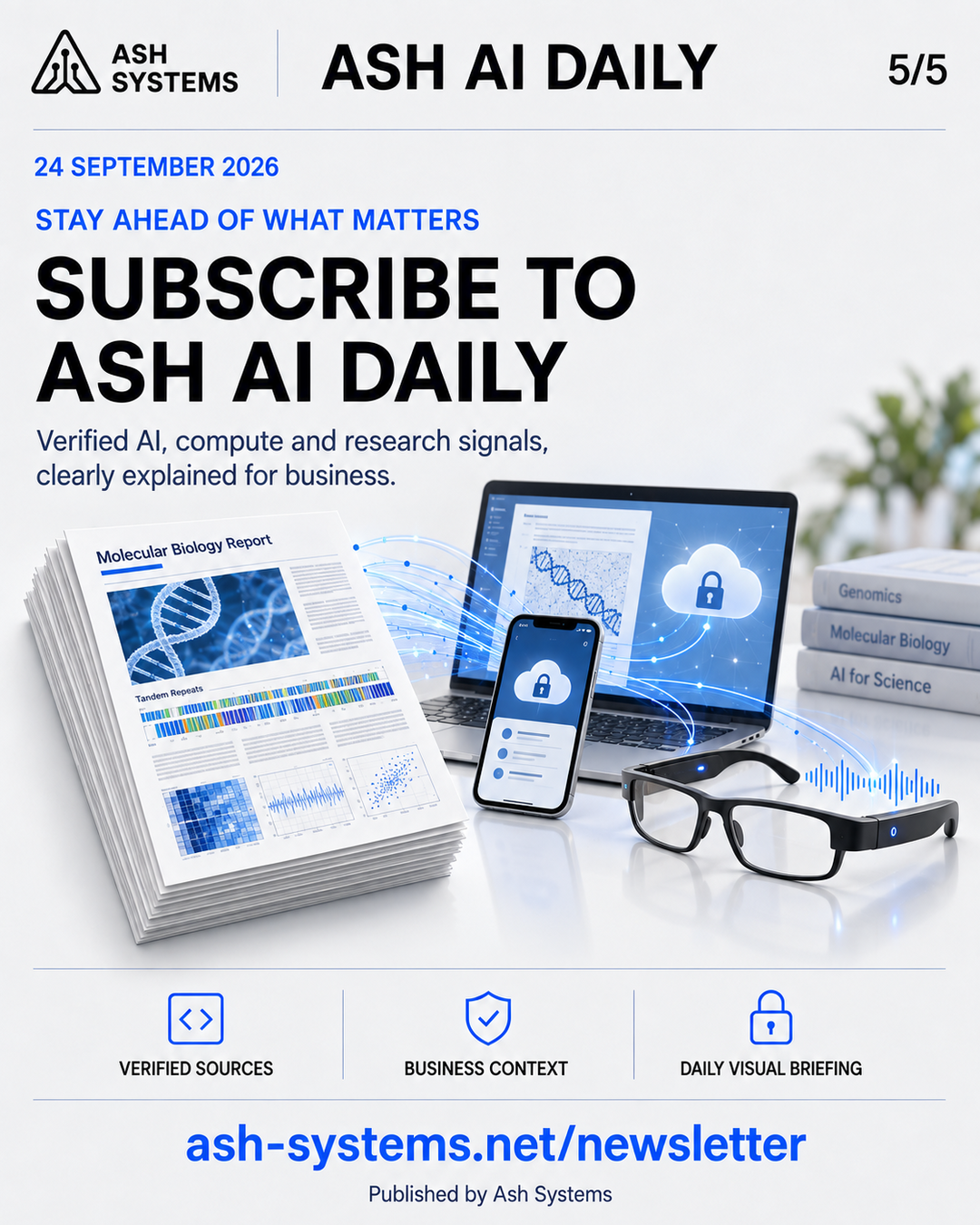
Subscribe to Ash AI Daily closing card
Closing watchlist

This issue includes a closing visual to carry the next-day watchlist or wrap-up prompt alongside the main briefing.

All issues
Previous issueSeptember 23, 2026Next issueSeptember 25, 2026
Ash AI Daily

Get the next issue in your inbox.

Join the source-linked daily briefing and confirm once before delivery begins.

Ash AI Daily

Ash Systems

Get the daily briefing

A concise, source-linked read on the AI news that changes what teams can build.

You will receive a confirmation email before any daily issue is sent.

Ash SystemsAsh Systems

Outcome-first engineering across AI, web, data, and automation. Secure, scalable, and practical.

Start a Conversationcontact@ash-systems.net+968 7505 0144

Product

ServicesSolutionsFlagship ProductsTestimonialsIndustriesFAQ

Company

AboutDocs and PapersCareersContact

Resources

AI NewsletterPrivacy PolicyTerms of ServiceCookie Policy

(c) 2026 Ash Systems (Private) Limited. All rights reserved.

Built with security and precision.