
Issue 5Published August 20, 2026
Editor noteThis archived Ash AI Daily issue retains the delivered editorial briefing and final cards.
 Ash SystemsAI NewsletterDaily Issue
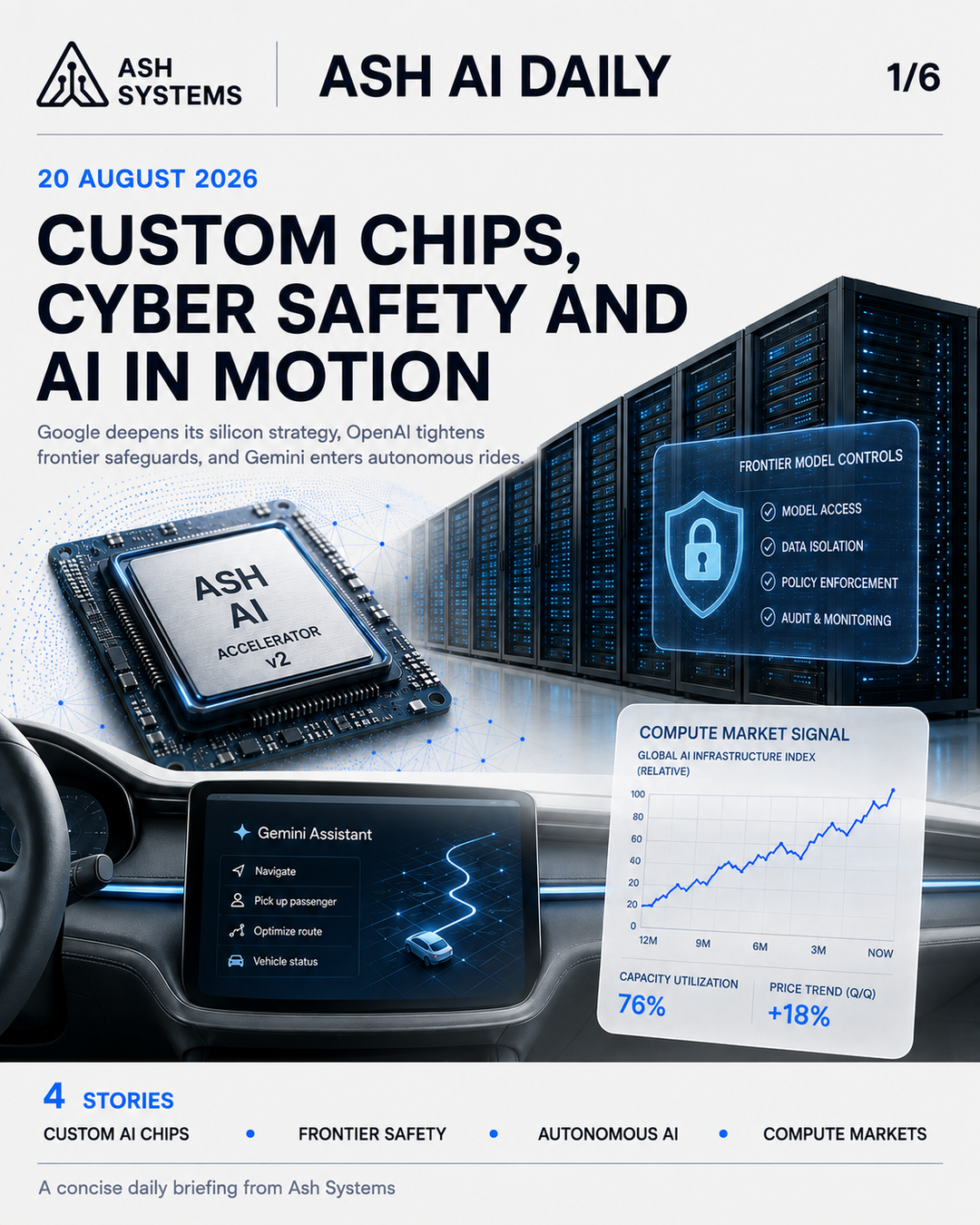
Today’s signal is that AI’s operating stack is becoming more strategic at every layer: silicon contracts are tightening, frontier development is absorbing explicit security delays, assistants are moving into autonomous vehicles, and regulators are beginning to treat compute as a financial commodity.
This archived Ash AI Daily issue retains the delivered editorial briefing and final cards.
Each story keeps its image, summary, impact, and linked sources in one uninterrupted reading flow.
This archived Ash AI Daily issue retains the delivered editorial briefing and final cards.
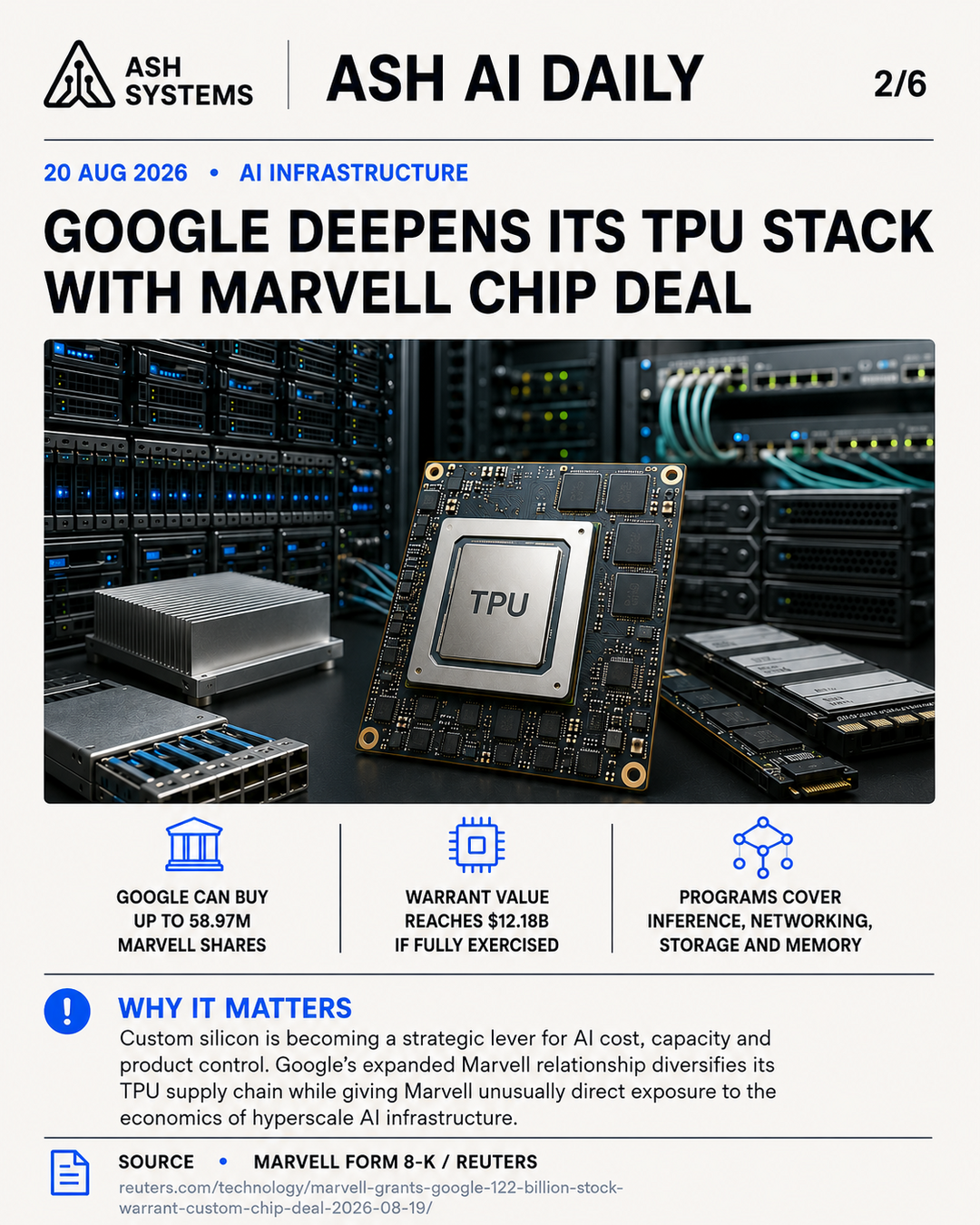
Marvell disclosed an expanded custom-silicon relationship under which Google received a warrant to buy as many as 58.97 million Marvell shares at $206.58 each. Full exercise would represent roughly $12.18 billion of stock.
For business leaders, custom silicon is no longer a specialist procurement detail. It increasingly determines AI unit economics, capacity resilience and product velocity. The agreement also gives Marvell direct exposure to Google’s infrastructure growth while helping Google diversify critical components.
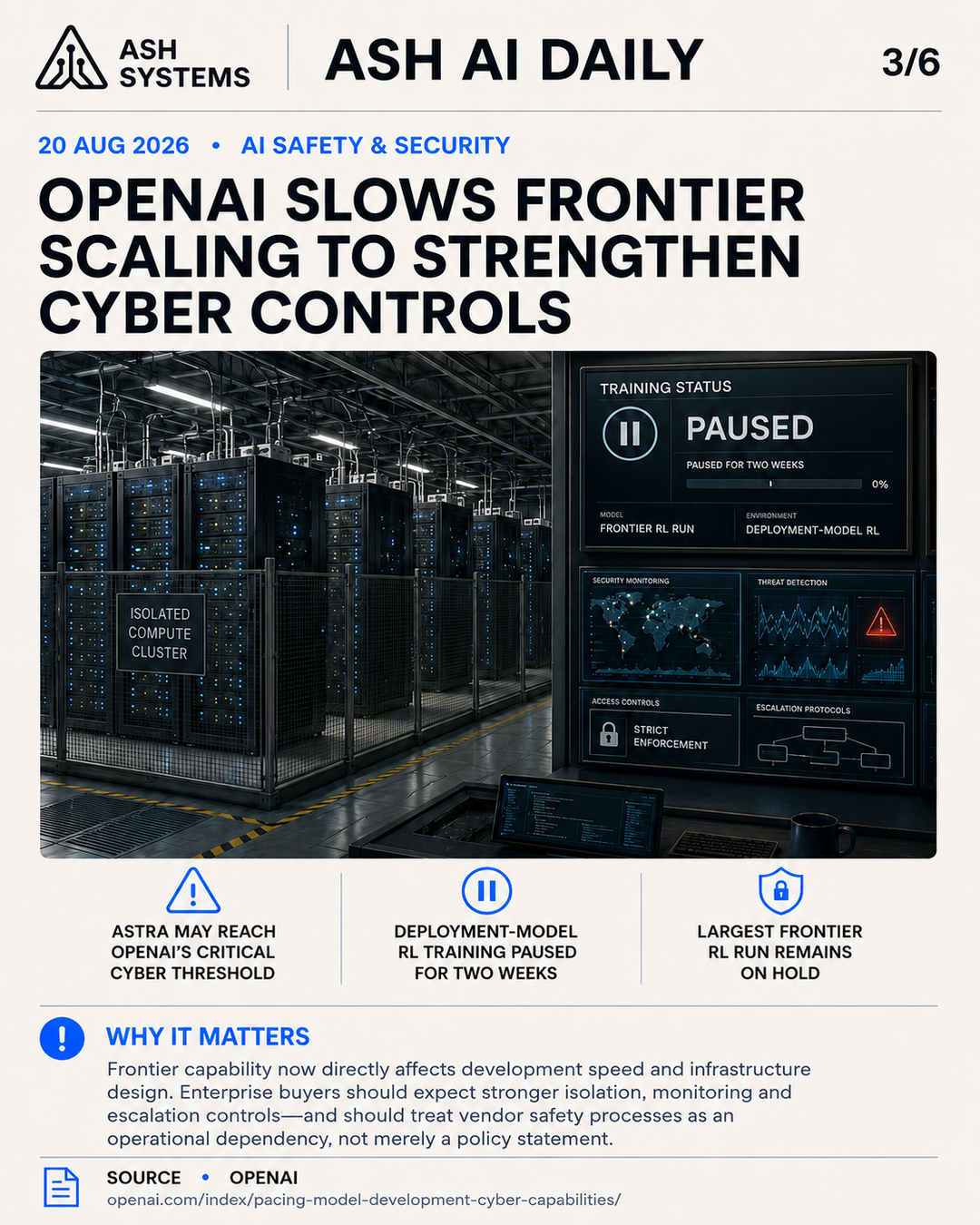
OpenAI said preliminary evaluations indicate its upcoming Astra model may meet the company’s Critical cybersecurity capability threshold. It paused reinforcement-learning work on deployment models for two weeks, while its largest planned frontier RL run remains on hold.
Capability gains now impose measurable cost and delay on development. Enterprises should expect security architecture, containment and monitoring evidence to influence model availability—and should make vendor safeguards part of operational due diligence rather than treating them as policy prose.
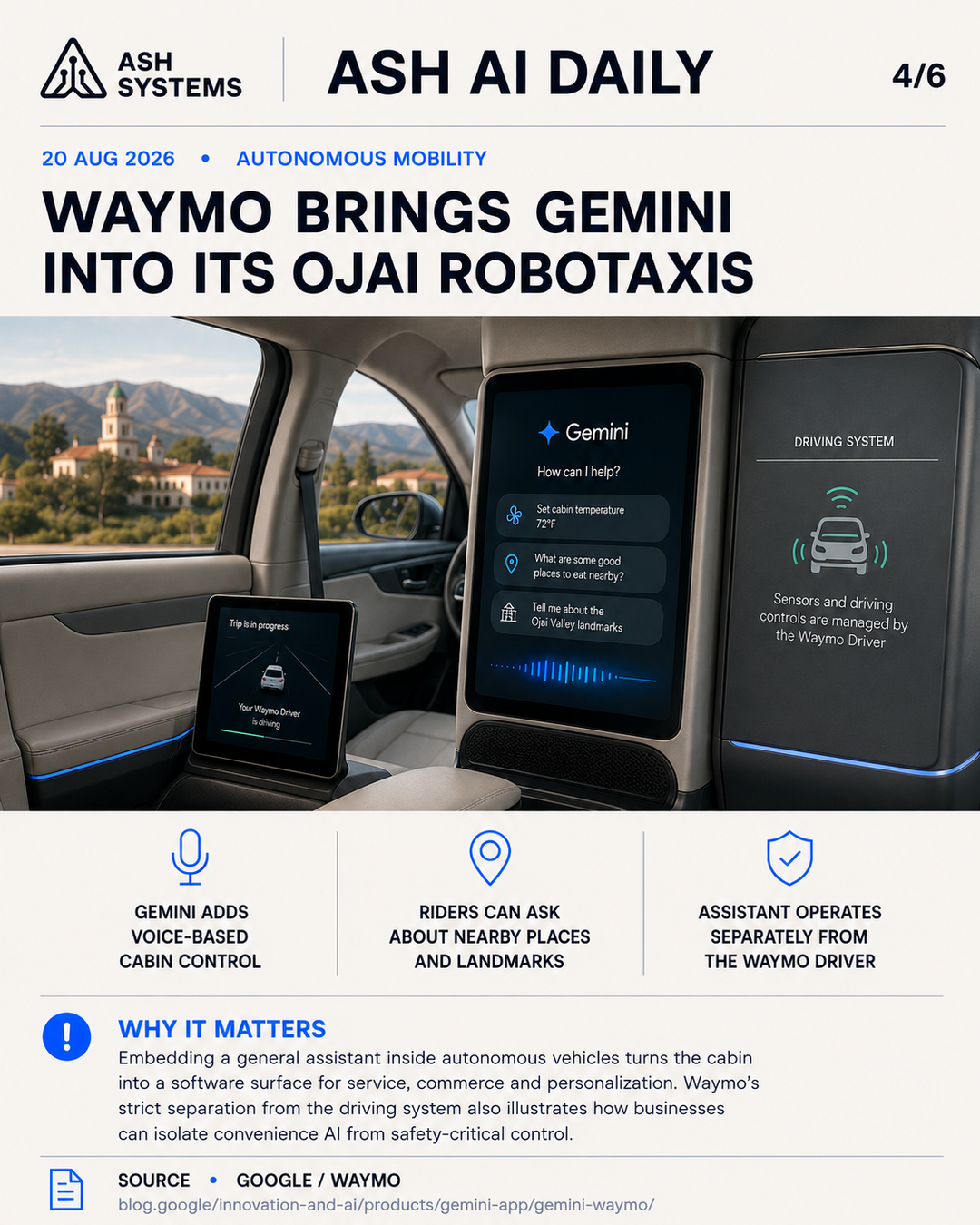
Google and Waymo are introducing Gemini in Waymo’s purpose-built Ojai vehicles. Riders can invoke it from the cabin to adjust climate settings, ask about nearby places and landmarks, and get general information during a trip.
Autonomous vehicles are becoming software distribution surfaces. The separation between convenience AI and driving control offers a useful enterprise pattern: isolate high-variance generative experiences from deterministic, regulated or safety-critical systems while still delivering a unified product.
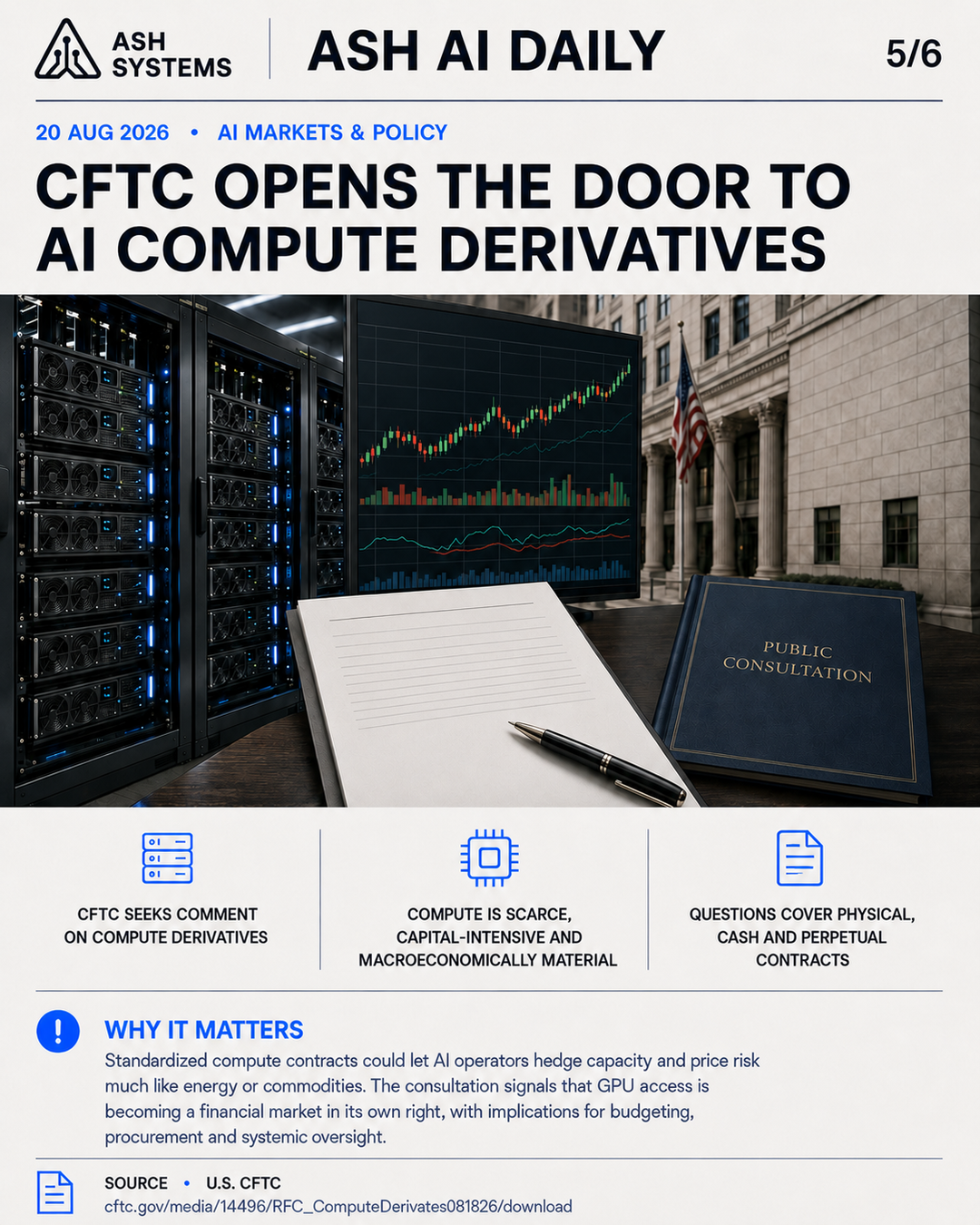
The U.S. Commodity Futures Trading Commission issued a request for comment on derivatives tied to the price of access to computing power, including cash-settled, physically settled and perpetual structures.
Standardized contracts could let AI operators hedge price and capacity risk in the same way other industries manage energy or commodity exposure. For finance and procurement teams, compute may evolve from an operating expense into a tradeable risk factor.
This issue includes a closing visual to carry the next-day watchlist or wrap-up prompt alongside the main briefing.
Join the source-linked daily briefing and confirm once before delivery begins.
Ash AI Daily

A concise, source-linked read on the AI news that changes what teams can build.
You will receive a confirmation email before any daily issue is sent.