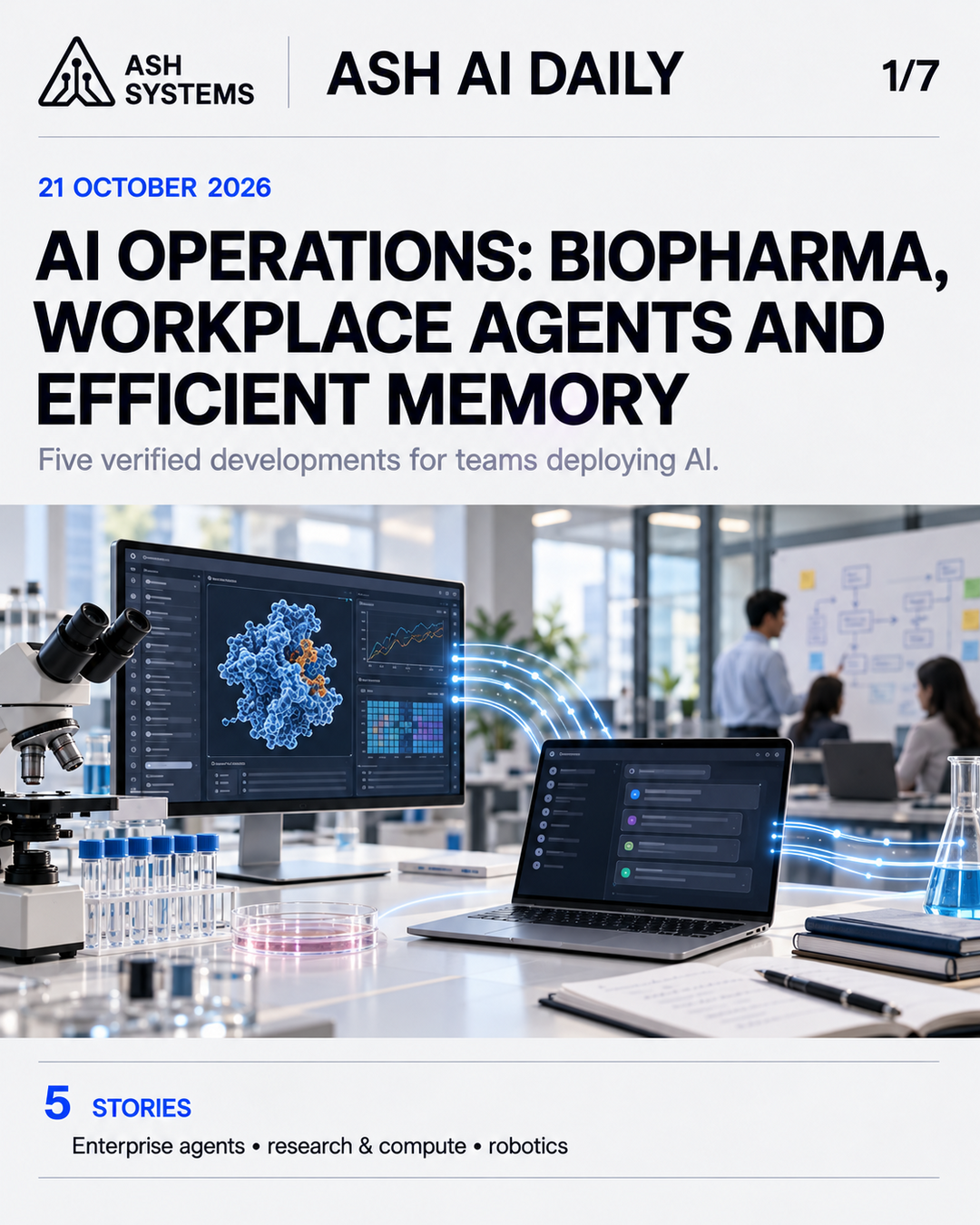
Issue 76Published October 21, 2026
Editor noteThis archived Ash AI Daily issue retains the delivered editorial briefing and final cards.
 Ash SystemsAI NewsletterDaily Issue
Five verified developments for teams deploying AI, spanning life-sciences operations, workplace agents, efficient long-context methods, surgical simulation, and learned agent memory.
This archived Ash AI Daily issue retains the delivered editorial briefing and final cards.
Each story keeps its image, summary, impact, and linked sources in one uninterrupted reading flow.
This archived Ash AI Daily issue retains the delivered editorial briefing and final cards.
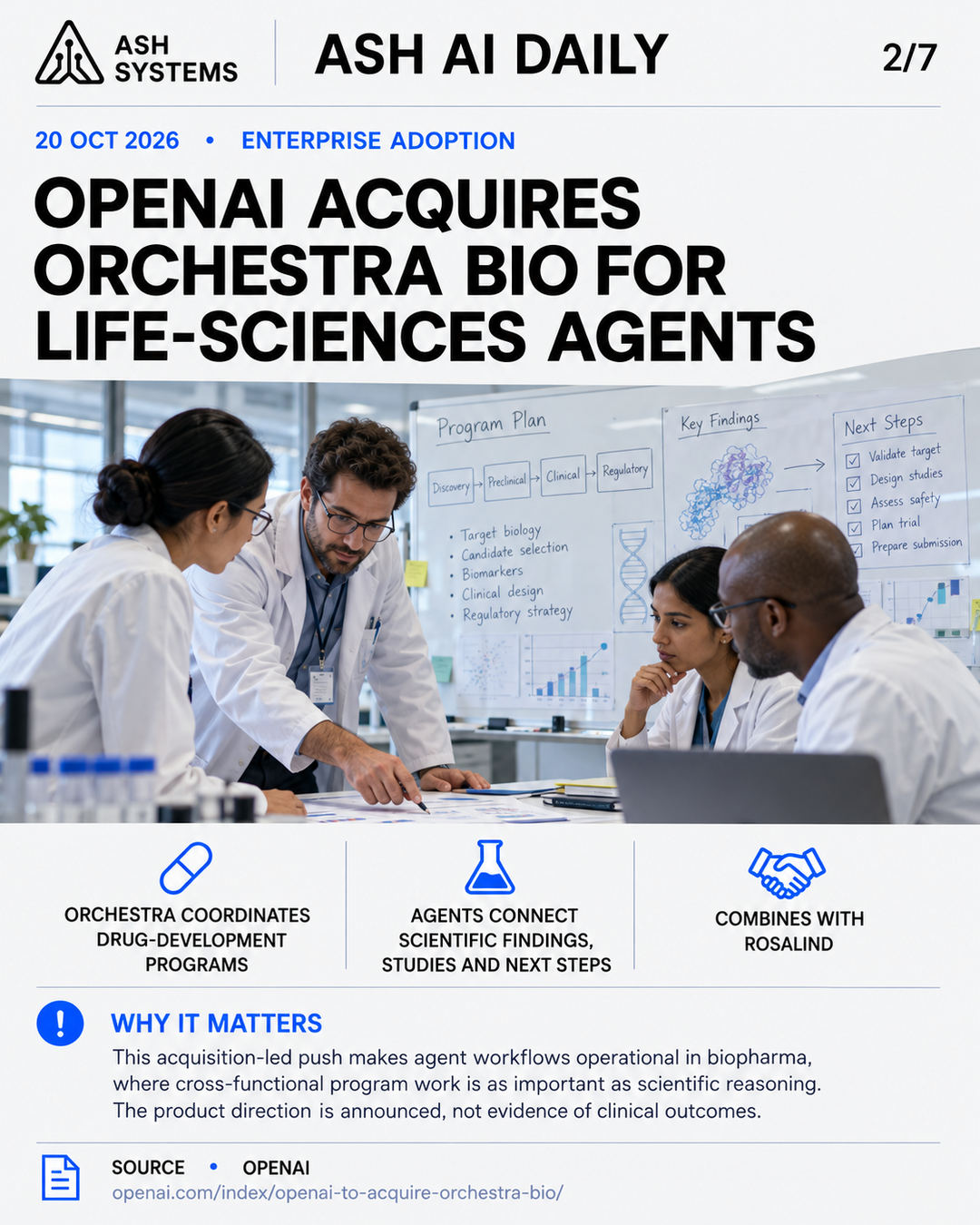
OpenAI said it acquired Orchestra Bio, a platform used by biopharma teams to coordinate drug-development programs. It will combine Orchestra’s technology and team with Rosalind, OpenAI’s life-sciences tools, aiming to connect scientific findings, studies, decisions and follow-up work.
The move brings agent workflows into an operational layer of biopharma, where coordination across studies, manufacturing and regulatory work can be as consequential as a model’s scientific reasoning. It is a product-direction announcement, not evidence of clinical outcomes.
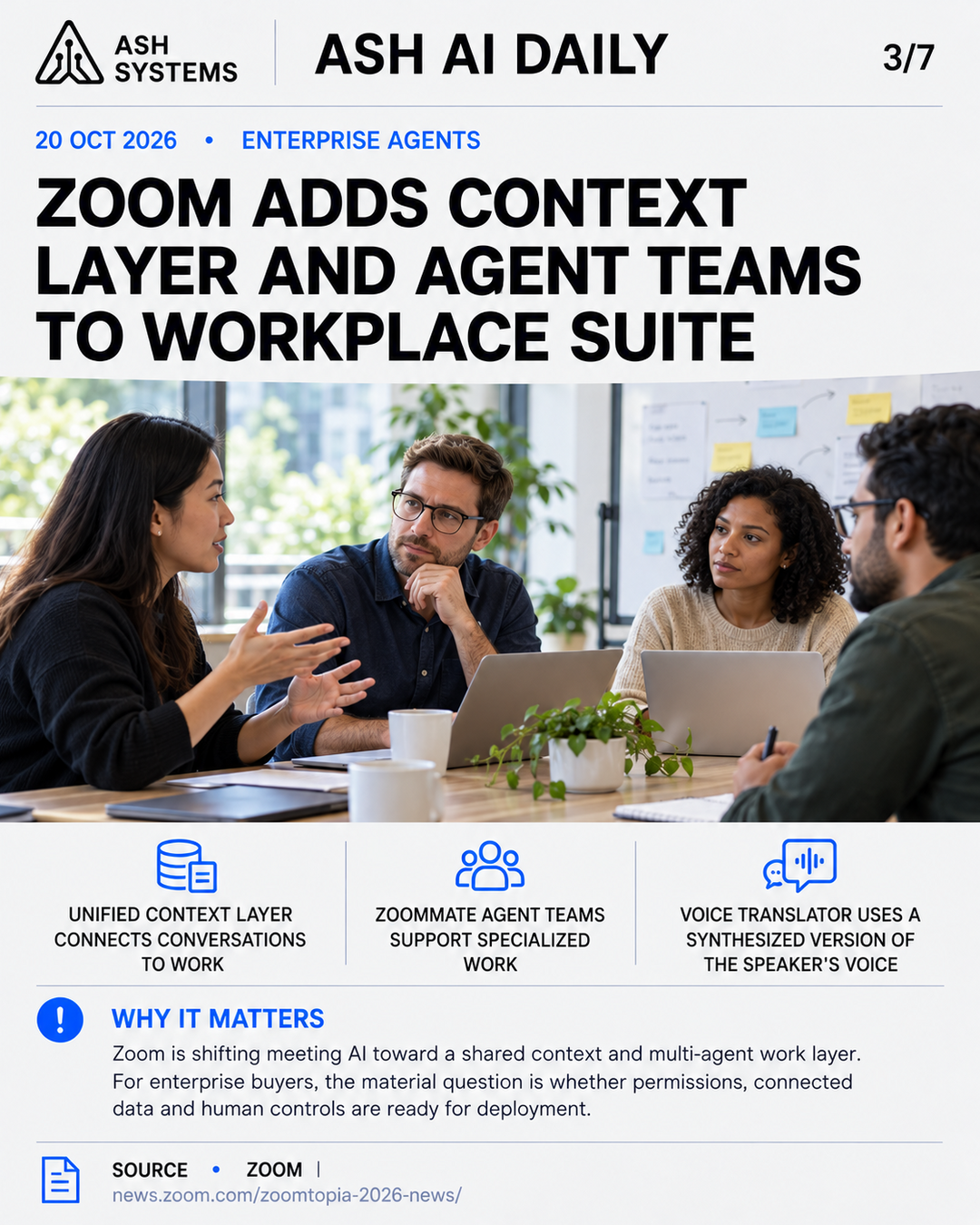
At Zoomtopia, Zoom announced a Unified Context Layer intended to connect work context across its suite, along with ZoomMate Agent Teams for specialized work. The company also described a voice translator that can use a synthesized version of a speaker’s voice.
Zoom is shifting meeting AI toward shared context and multi-agent work. For enterprise buyers, the material question is whether identity, permissions, connected data and human controls are ready for deployment—not simply whether the assistant can summarize a call.
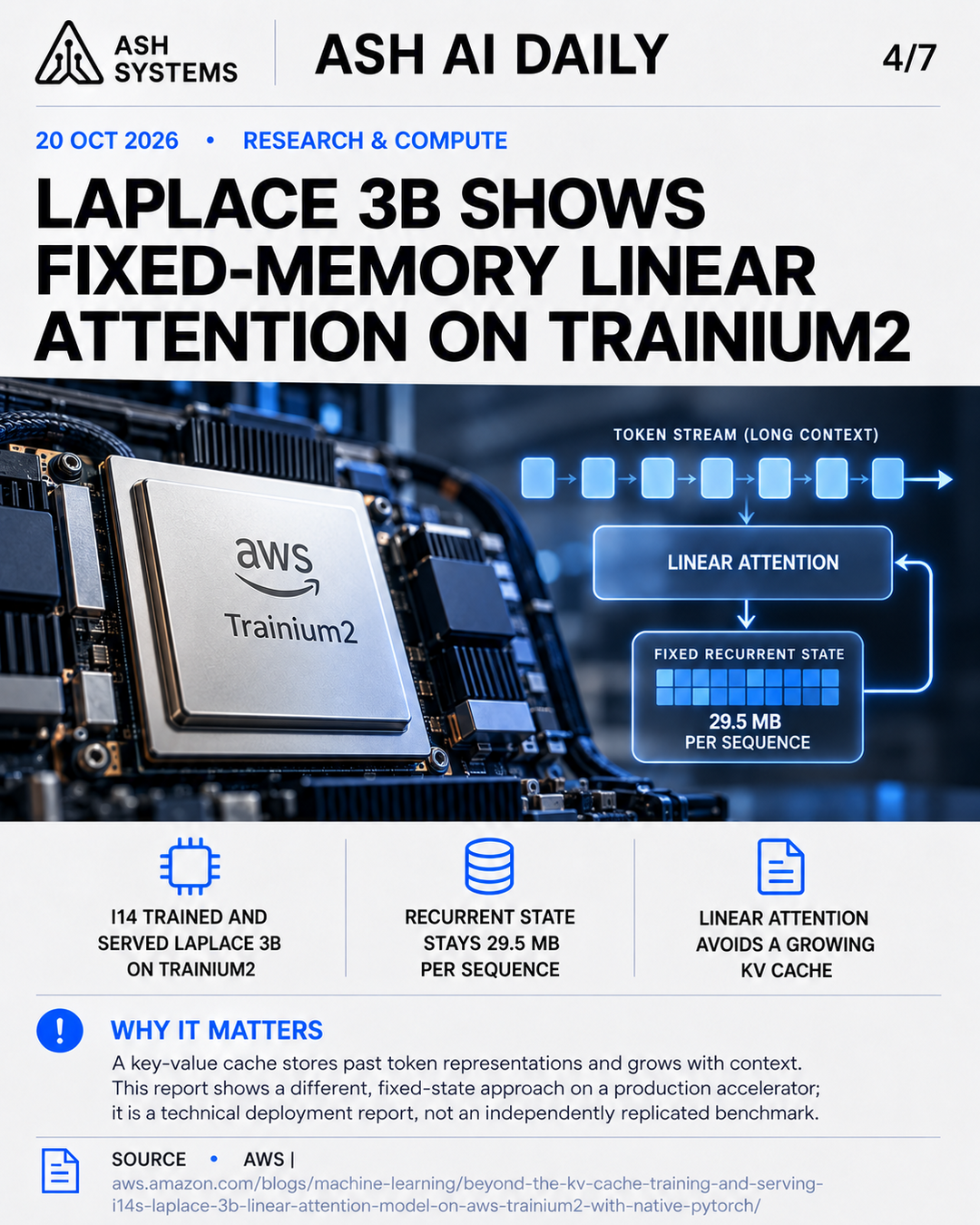
AWS documented i14’s training and serving of Laplace 3B on Trainium2 with native PyTorch. The model uses linear attention and a fixed recurrent state rather than a growing key-value cache; AWS reports 29.5 MB of state per sequence in its serving setup.
A key-value cache stores past token representations and normally grows with context length. This is a technical deployment report—not an independently replicated benchmark—but it shows how a fixed-state approach could alter the infrastructure economics of long-context workloads.
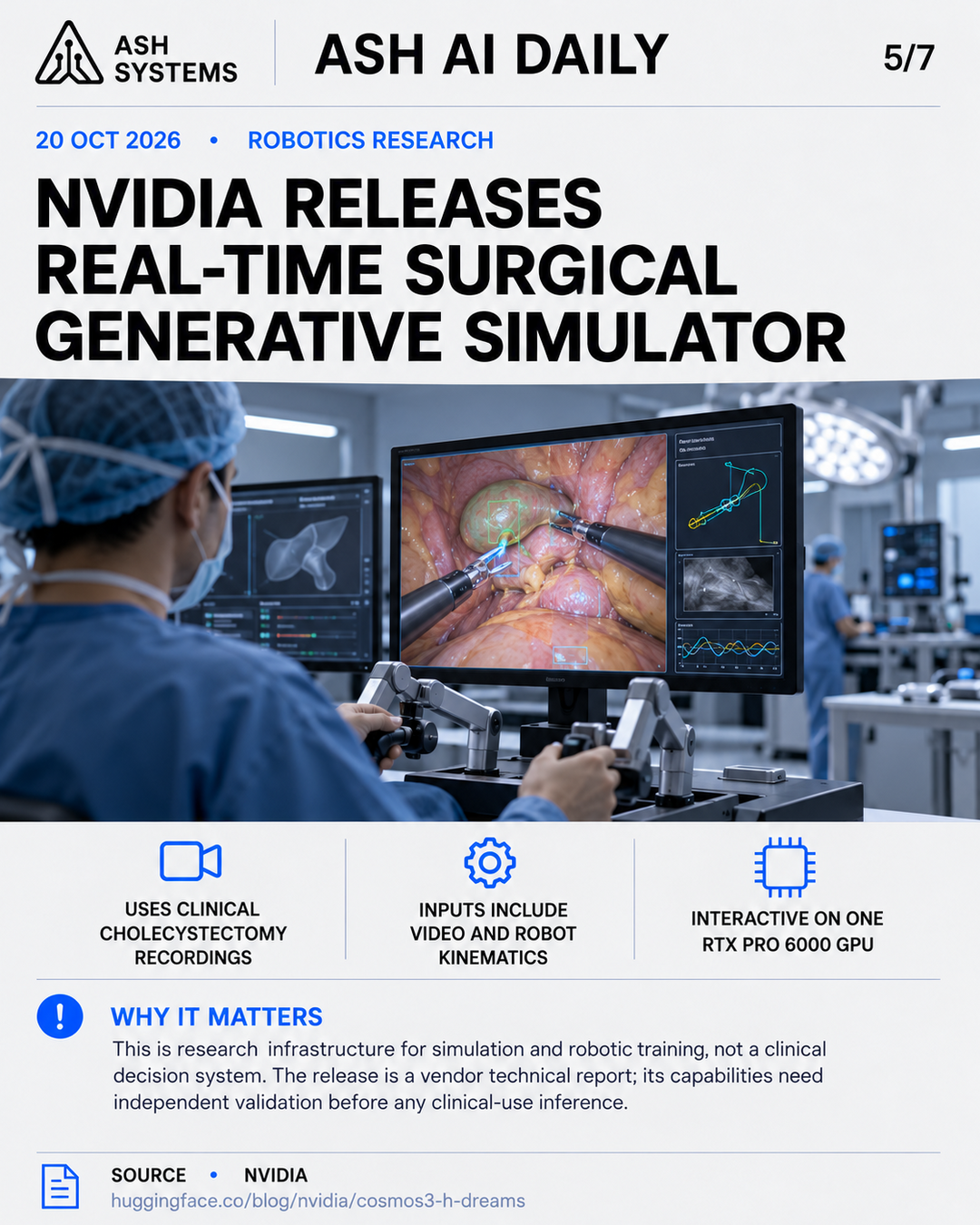
NVIDIA introduced Cosmos3-H-Dreams, a research system trained on clinical cholecystectomy video and robot-kinematics recordings from the CMR Surgical Versius platform. NVIDIA says the action-conditioned simulator runs interactively on one RTX PRO 6000 GPU using Cosmos 3 and FlashDreams.
This is research infrastructure for simulation and robotics training, not a clinical decision system. The capability is vendor-reported and needs independent validation—especially for biomechanical accuracy—before it supports any clinical-use inference.
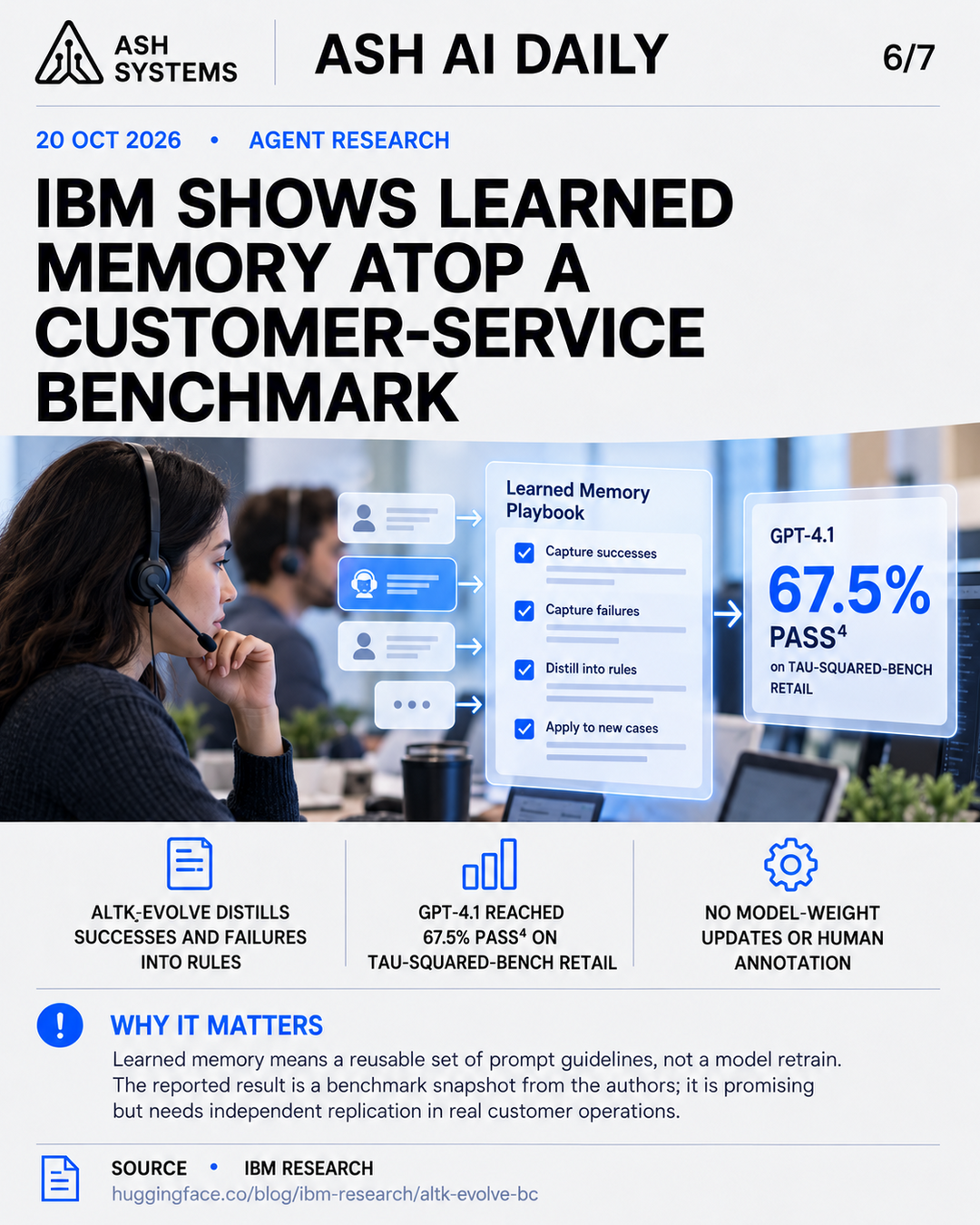
IBM Research reported that ALTK-Evolve uses GPT-4.1 to distill an agent’s successes and failures into reusable prompt guidelines, without changing model weights or adding human annotations. IBM reports a 67.5% Pass⁴ result on the retail slice of τ²-bench in an October 12 leaderboard snapshot.
Learned memory here means a reusable playbook of prompt guidelines, not model retraining. The reported result is a benchmark snapshot from the authors: promising methodology, but it still needs independent replication and real-world customer-operations evidence.

This issue includes a closing visual to carry the next-day watchlist or wrap-up prompt alongside the main briefing.
Join the source-linked daily briefing and confirm once before delivery begins.
Ash AI Daily

A concise, source-linked read on the AI news that changes what teams can build.
You will receive a confirmation email before any daily issue is sent.