Issue 71Published October 16, 2026
Editor noteThis archived Ash AI Daily issue retains the delivered editorial briefing and final cards.
 Ash SystemsAI NewsletterDaily Issue
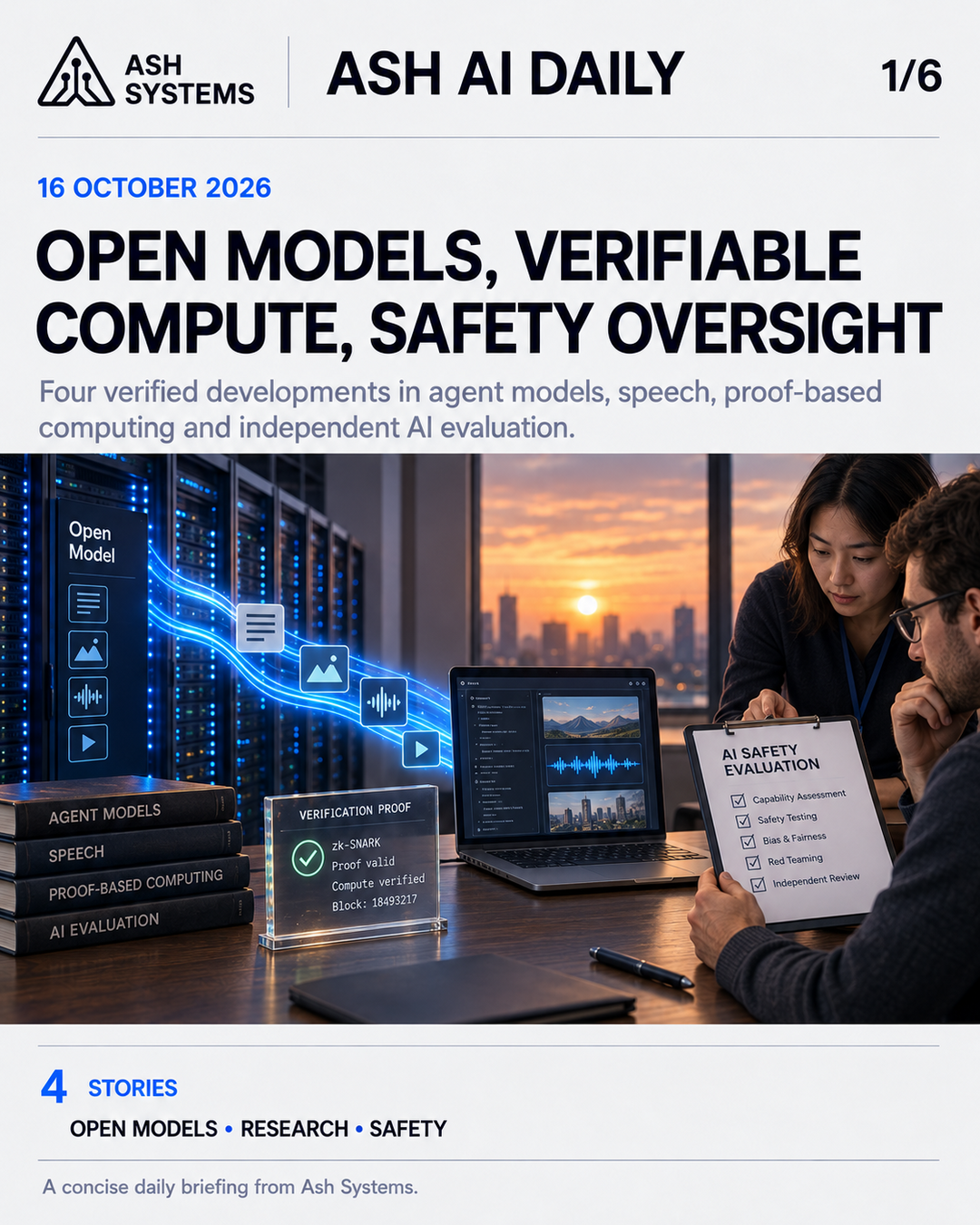
Today’s signal: open models widen the deployment envelope, while proof systems and independent evaluation point to more verifiable AI operations.
This archived Ash AI Daily issue retains the delivered editorial briefing and final cards.
Each story keeps its image, summary, impact, and linked sources in one uninterrupted reading flow.
This archived Ash AI Daily issue retains the delivered editorial briefing and final cards.
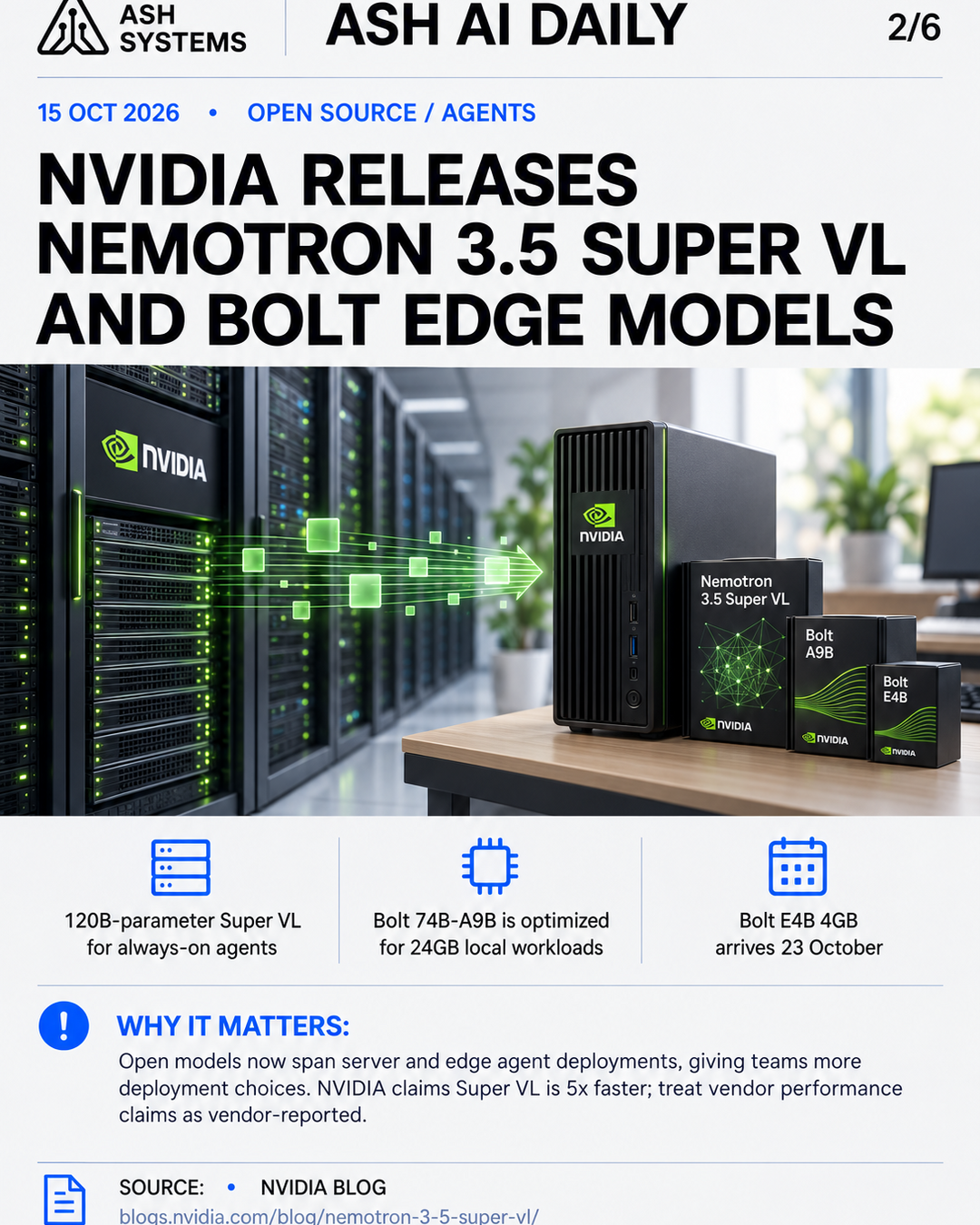
NVIDIA released the open 120-billion-parameter Nemotron 3.5 Super VL for multimodal agent workloads, alongside Bolt 74B-A9B 24GB for local systems and Bolt E4B 4GB for smaller edge deployments. Super VL and Bolt 74B-A9B are available now; NVIDIA says Bolt E4B is due 23 October. The claims on speed and accuracy are NVIDIA’s own benchmarks.
The release gives teams a broader open-model path from data-centre agents to local hardware, with more control over tuning, data residency and deployment. It also makes model-size and memory budget a more explicit architecture decision for always-on agents.
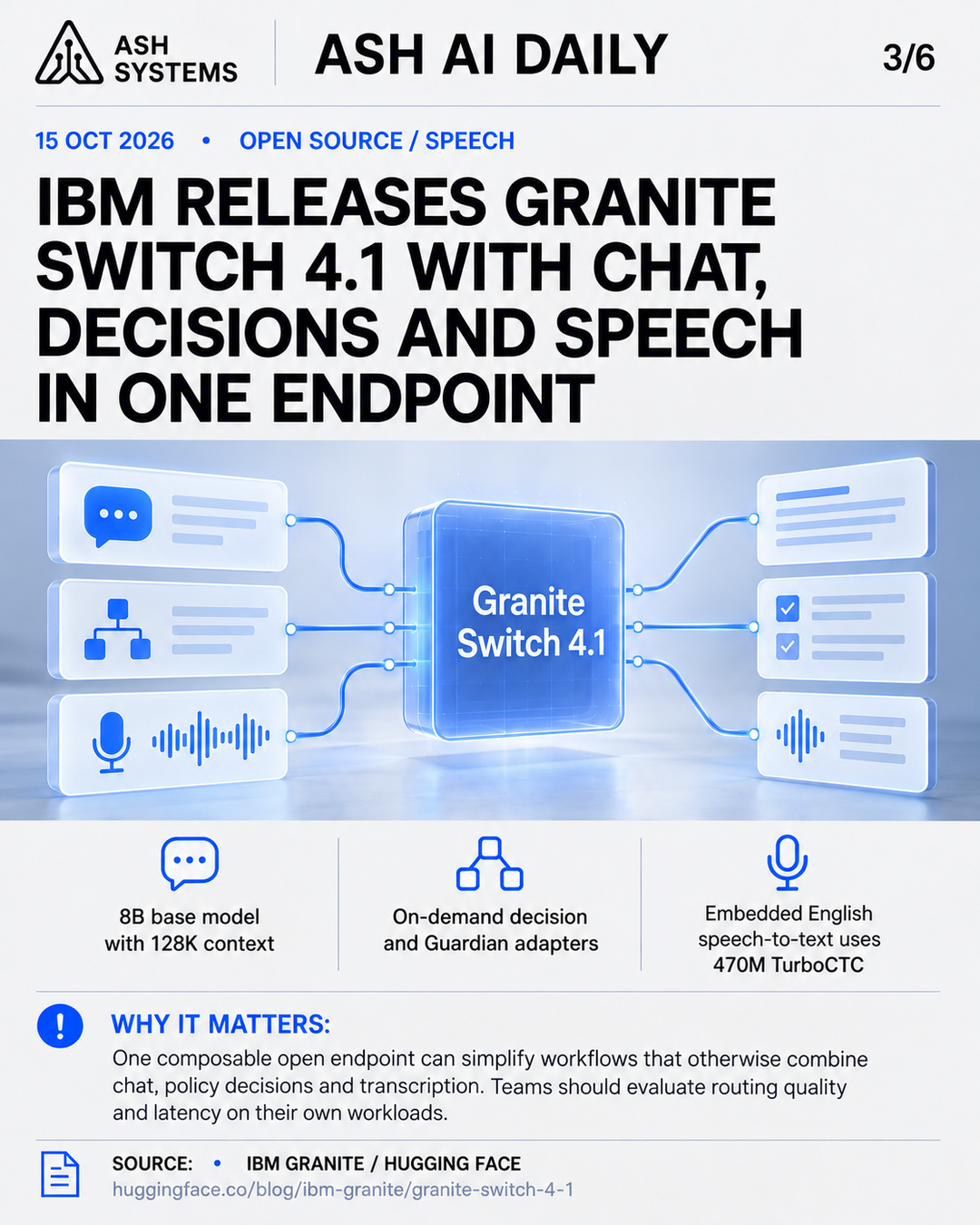
IBM’s Granite Switch 4.1 comes in 8B and 30B configurations and combines a general Decision aLoRA, a Guardian safety adapter and Granite-Speech-5.0-Turbo-CTC transcription. IBM says the adapters reuse the base model’s KV cache and occupy about the same GPU memory as the base model alone; the performance comparisons are publisher claims.
A single endpoint that can transcribe, classify and respond can reduce the glue code and GPU footprint of voice and workflow systems. Builders should still evaluate task accuracy and latency on their own data before replacing specialized components.
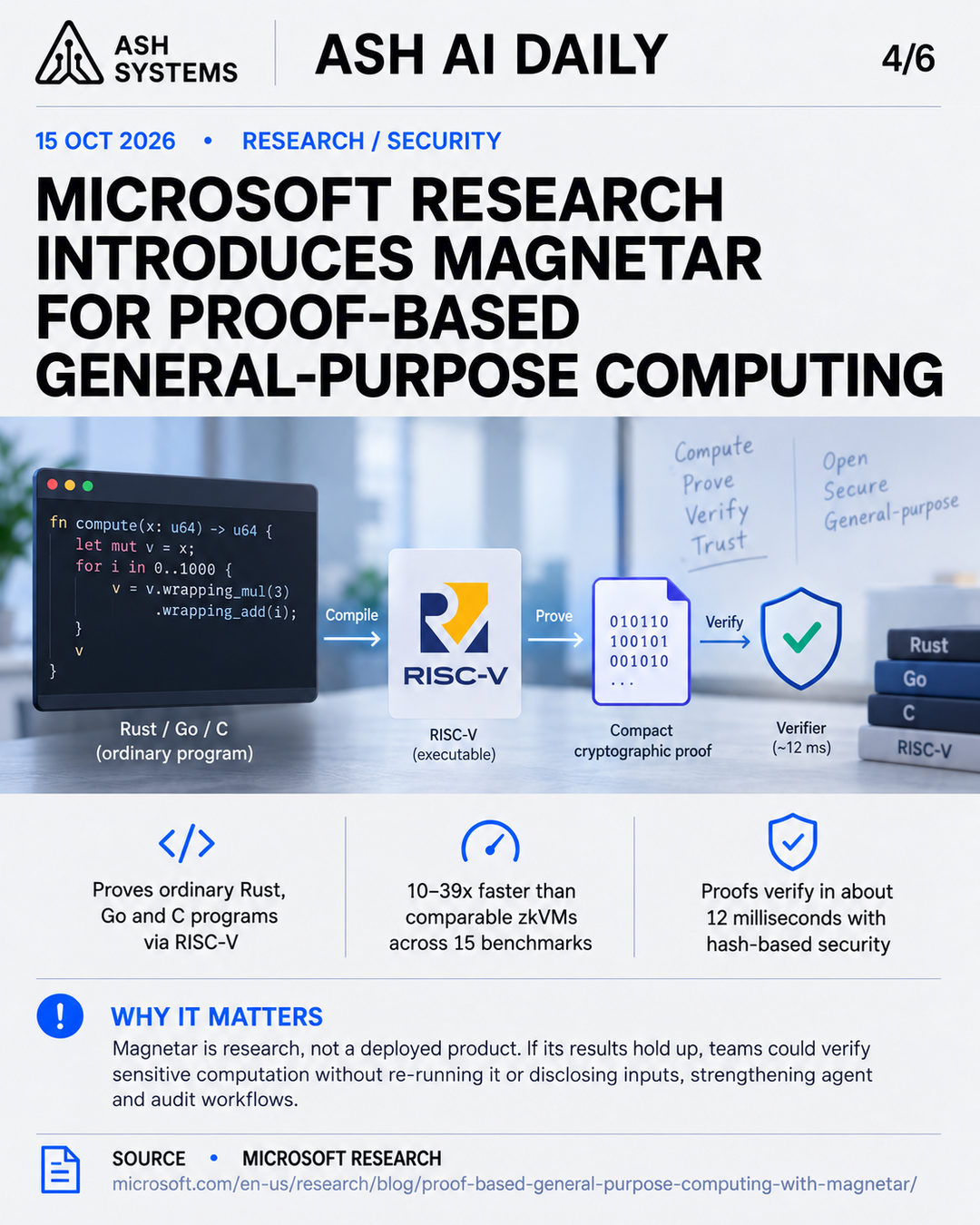
Microsoft Research introduced Magnetar, a research system for generating zero-knowledge proofs of programs written in Rust, Go or C. A zero-knowledge proof is a small, checkable certificate that a computation was performed correctly without exposing the input data or rerunning the workload. Microsoft reports 10–39× average speedups over comparable systems and hash-function-based, quantum-resistant security; this is research evidence, not a deployed product claim.
If the reported results hold in independent use, proof-carrying computation could make outsourced or AI-adjacent processing more auditable without exposing sensitive inputs. The practical question is whether proof-generation overhead fits real production workloads.
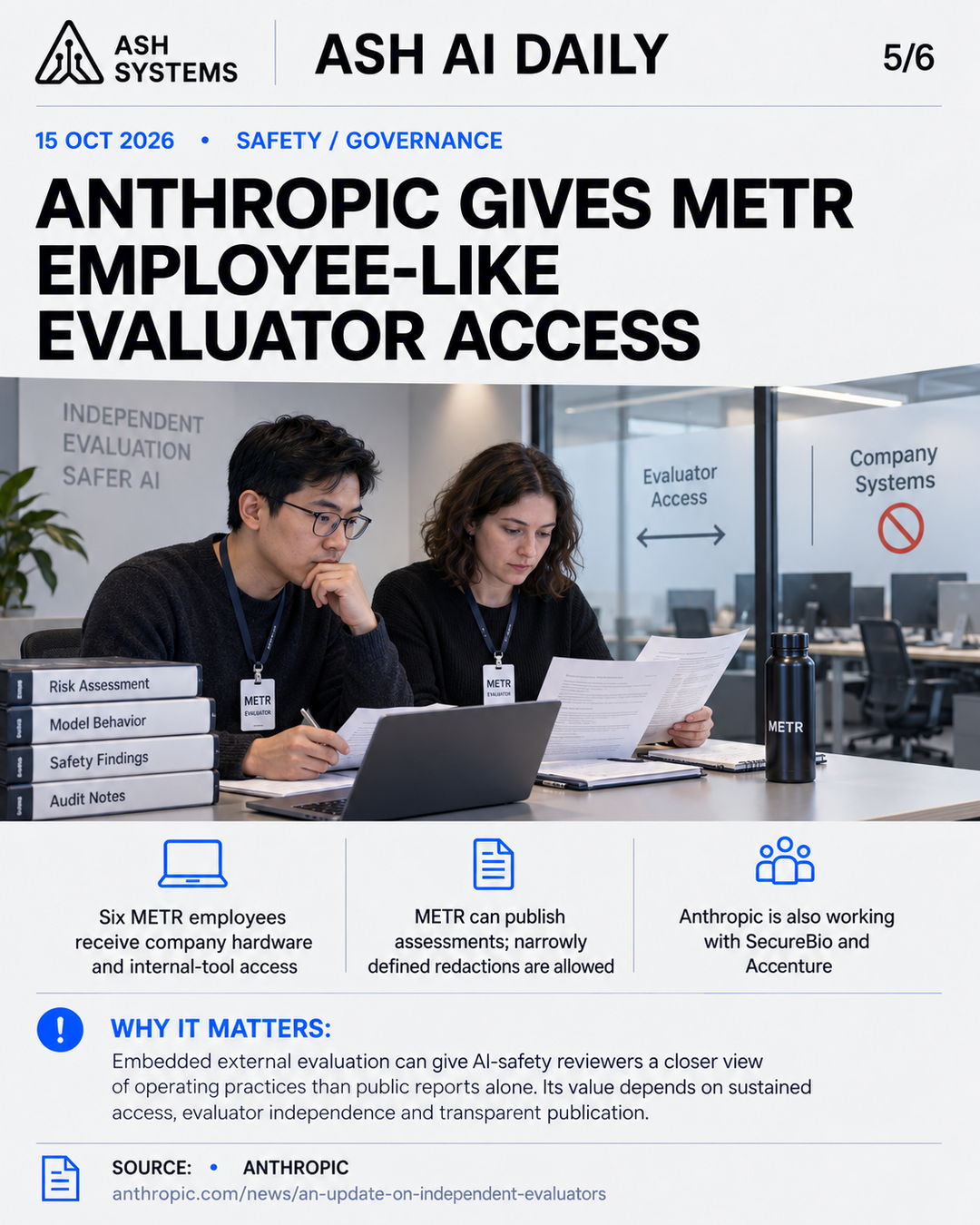
Anthropic says it has onboarded six METR employees with company hardware, office space and access roughly comparable to its own risk-assessment teams, subject to defined exclusions such as customer data, privileged information and model architectures. METR can publish its assessments without Anthropic approval, while Anthropic may require narrowly defined redactions that METR may characterize publicly.
This is a concrete experiment in independent AI oversight rather than a general policy pledge. It gives buyers and policymakers a clearer model for what meaningful evaluator access and publication rights can look like, while the arrangement’s effectiveness remains to be tested in practice.

This issue includes a closing visual to carry the next-day watchlist or wrap-up prompt alongside the main briefing.
Join the source-linked daily briefing and confirm once before delivery begins.
Ash AI Daily

A concise, source-linked read on the AI news that changes what teams can build.
You will receive a confirmation email before any daily issue is sent.