Issue 69Published October 14, 2026
Editor noteThis archived Ash AI Daily issue retains the delivered editorial briefing and final cards.
 Ash SystemsAI NewsletterDaily Issue
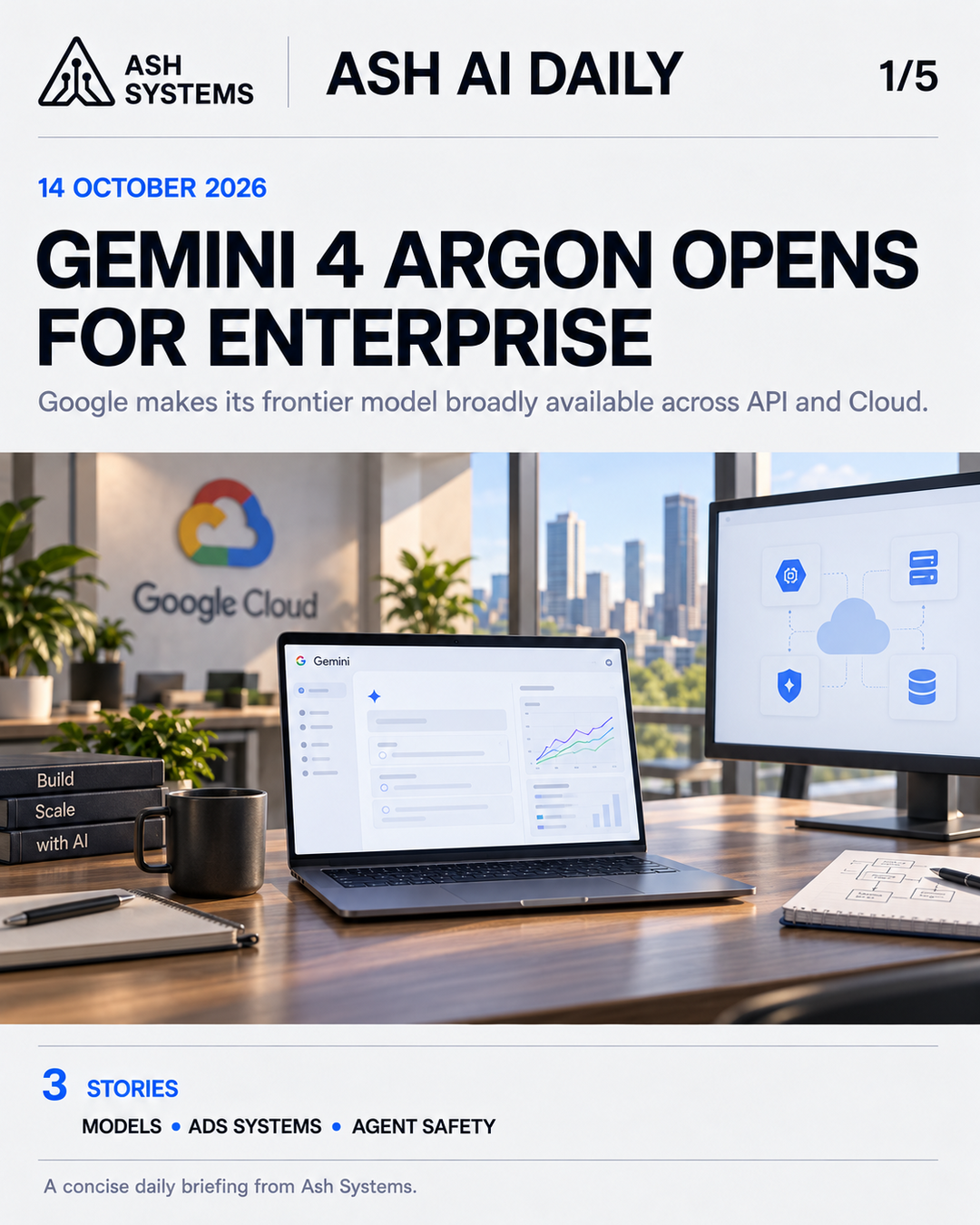
Three verified signals for AI builders and operators: a new enterprise model endpoint, a scaled recommender system, and a practical agent-isolation pattern.
This archived Ash AI Daily issue retains the delivered editorial briefing and final cards.
Each story keeps its image, summary, impact, and linked sources in one uninterrupted reading flow.
This archived Ash AI Daily issue retains the delivered editorial briefing and final cards.
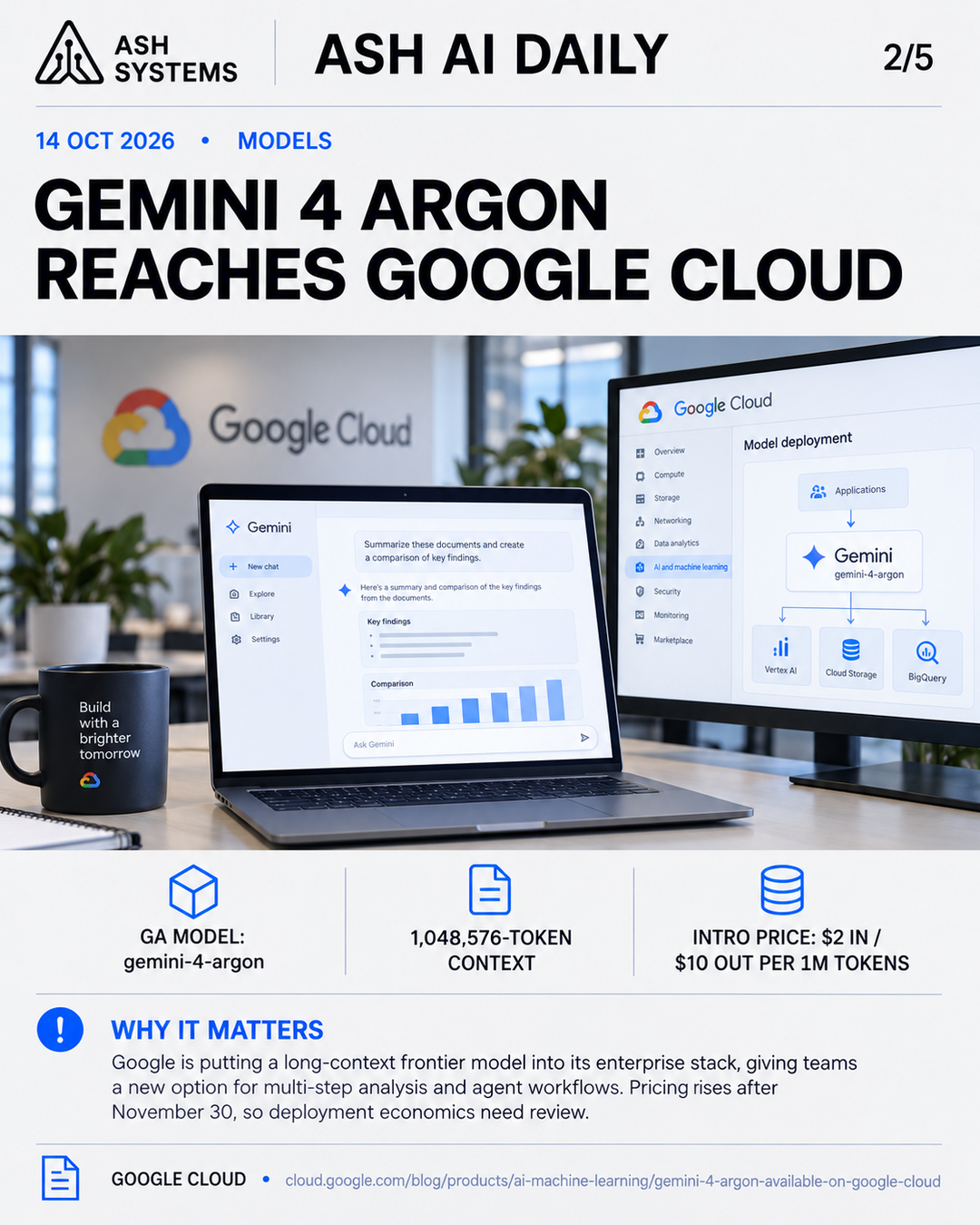
Google Cloud made Gemini 4 Argon generally available under the gemini-4-argon model ID. Google’s release notes list a 1,048,576-token context window shared across input, thinking and output, configurable thinking levels, and agentic video understanding in GA. Introductory API pricing is $2 per million input tokens and $10 per million output tokens through 30 November 2026; Google says standard pricing then becomes $4 and $20.
Google is putting a long-context frontier model into its enterprise stack, giving teams a new option for multi-step analysis and agent workflows. Pricing rises after November 30, so deployment economics need review.
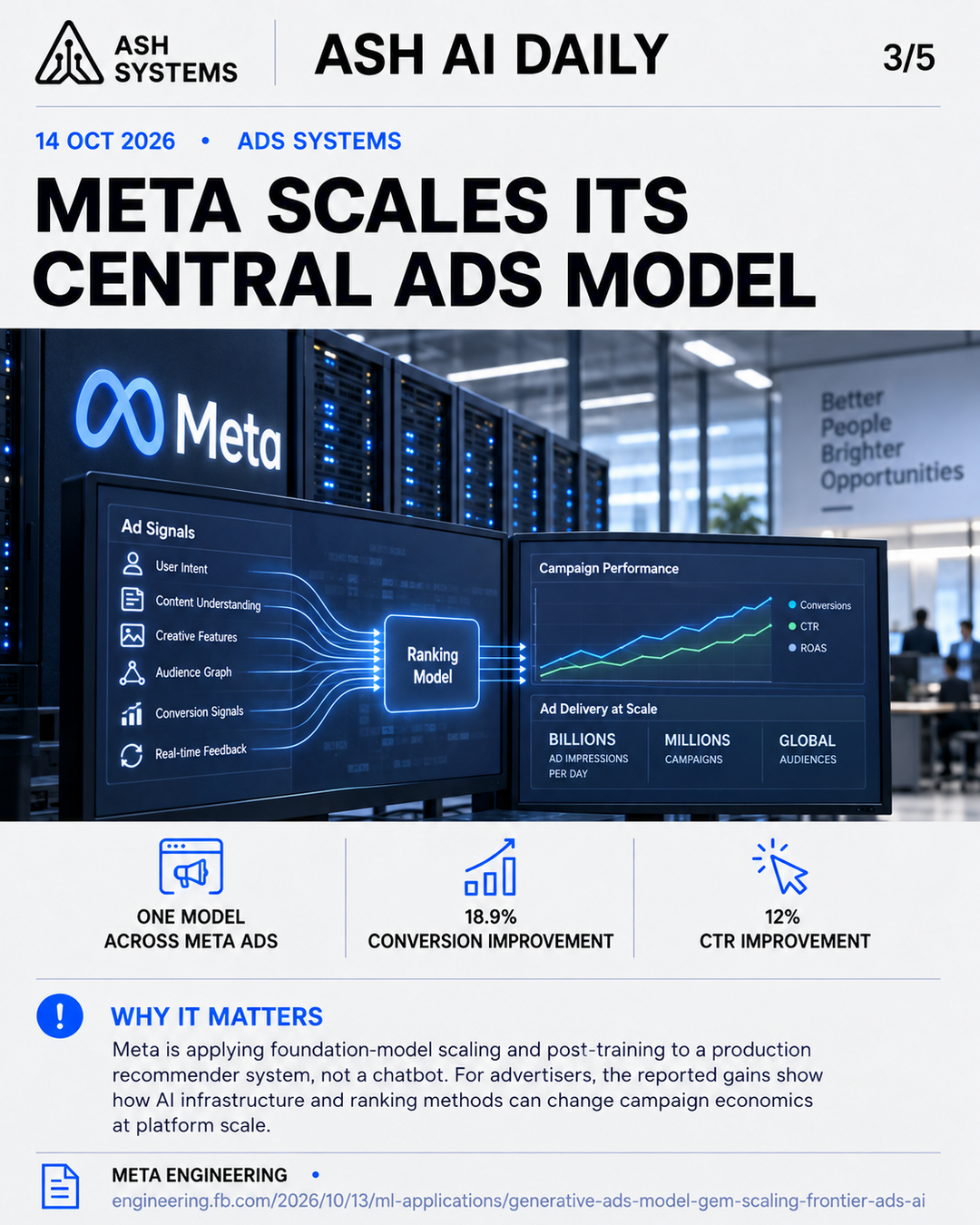
Meta Engineering says its 2026 Generative Ads Model (GEM) moves from separate per-domain systems to one central foundation model spanning its ads surfaces and objectives. Meta reports that GEM delivered an 18.9% conversion improvement and a 12% click-through-rate improvement across those surfaces and objectives, while its next-generation stack uses more compute, intelligence transfer and post-training methods. These are Meta-reported production outcomes, not independently audited measurements.
Meta is applying foundation-model scaling and post-training to a production recommender system, not a chatbot. For advertisers, the reported gains show how AI infrastructure and ranking methods can change campaign economics at platform scale.
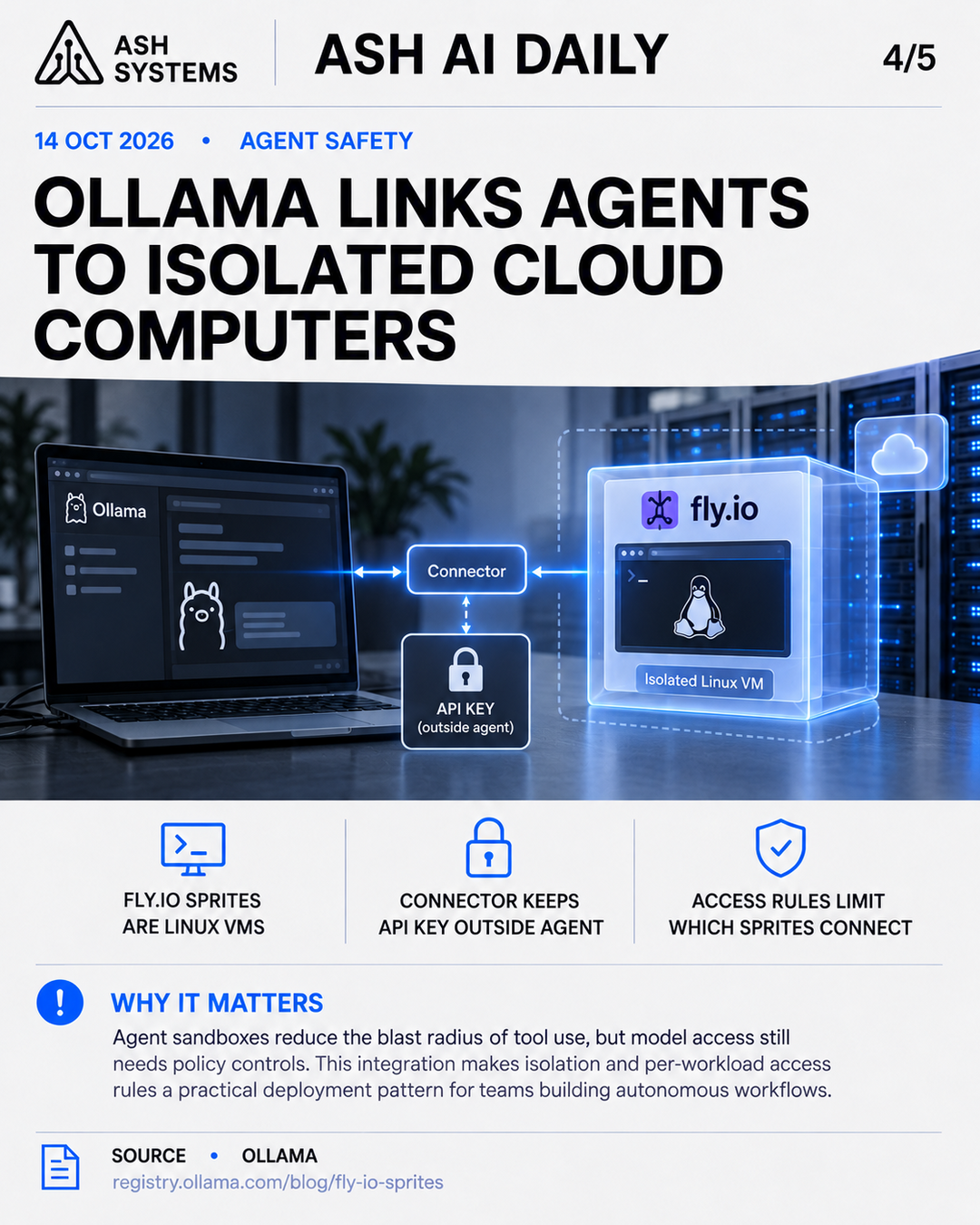
Ollama announced an integration with Fly.io Sprites, persistent full-Linux virtual machines designed for agents. The Ollama Connector routes calls through a Fly.io gateway; Fly.io says the Sprite receives only a gateway URL and connection ID rather than the Ollama API key. New connectors block Sprites by default, with access configurable by label, name prefix or all Sprites.
Agent sandboxes reduce the blast radius of tool use, but model access still needs policy controls. This integration makes isolation and per-workload access rules a practical deployment pattern for teams building autonomous workflows.
This issue includes a closing visual to carry the next-day watchlist or wrap-up prompt alongside the main briefing.
Join the source-linked daily briefing and confirm once before delivery begins.
Ash AI Daily

A concise, source-linked read on the AI news that changes what teams can build.
You will receive a confirmation email before any daily issue is sent.